








What is the story about?
DURHAM, N.C. (AP) — Duke University has developed a groundbreaking robot named Argus, designed to move and perceive its environment in any direction. This
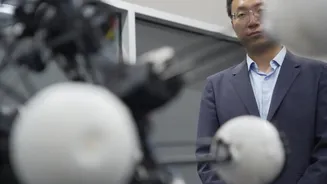
innovative robot features 20 legs and advanced depth-sensing cameras, enabling it to navigate diverse terrains with agility. Engineering professor Boyuan Chen and his team focused on a concept they call 'dynamic symmetry,' prioritizing movement over traditional symmetrical designs. This approach allows Argus to function without a defined front or back, enhancing its versatility in various settings.
Design and Functionality of Argus
Argus, named after the mythological giant with many eyes, is equipped with telescoping legs that extend from a central core. This design facilitates instant movement and visual perception in all directions. Chen emphasized the importance of dynamic movement, stating, 'Who said, you know, if you have a robot to help us in a most effective way, it has to look like us?'Performance in Various Environments
In practical tests, Argus has demonstrated its ability to traverse sandy beaches and dense forest areas, overcoming obstacles and maintaining stability when pushed. Its unique leg movements allow it to climb between narrow spaces, showcasing its adaptability. 'Watching Argus move is unlike watching any other robot we’ve worked with,' said Jiaxun Liu, a graduate student involved in the project.Dynamic Isotropy and Future Applications
Researchers have introduced a new design principle termed dynamic isotropy, which evaluates robots based on their ability to accelerate uniformly in all directions. Argus achieved a score of 0.91, significantly higher than most existing robots, which typically score below 0.6. Chen expressed hope that this principle could influence the design of various types of robots, including those for search and rescue operations.Chen elaborated on future applications, suggesting that Argus could serve as a versatile tool for manipulating objects from various angles, rather than conforming to traditional robotic designs. He stated, 'The knowledge we can transfer to the rest of the world is much more deeper than building an existing robot or copying an existing species.'