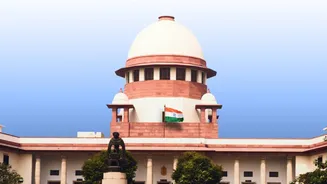









The Centre on Thursday informed the Supreme Court (SC) that is is currently working on suggestions for implementing the CBSE’s three-language policy that required
Class 9 students to study three languages, with two native Indian languages being compulsory. Additional Solicitor General Aishwarya Bhati told a bench comprising Chief Justice Surya Kant and Justices Joymalya Bagchi and V Mohana that CBSE is in the process of working out various modalities and sought time, PTI stated. The apex court noted the submission and deferred the matter to next week. Supreme Court on August 20 had stressed the need to find a solution to issues arising out of the CBSE’s three-language policy for Class 9 students. The Bench had reiterated that there was nothing wrong in introducing the policy, but the petitioners had raised concern over the manner in which it was being introduced. “You may revisit some of these problems. There is no doubt that sooner or later, it has to be introduced; there is nothing wrong with that. But how it is to be streamlined so that whatever impediments or blockades are coming up, you may find a solution to those,” the bench had said. Another issue raised in the Court was related to how to build adequate human resource infrastructure for the language options available. The national board had earlier stated in a notice that till the dedicated R3 textbooks are available, Class 9 students shall use Class 6 R3 textbooks (2026-27 edition) of the chosen language. Central Board of Secondary Education (CBSE) introduced the three-language policy from the 2026-27 academic year. This is in line with the National Education Policy (NEP) 2020 and the National Curriculum Framework for School Education (NCF-SE) 2023. Under the new R1-R2-R3 framework, students are expected to learn three languages, with at least two being native Indian languages.