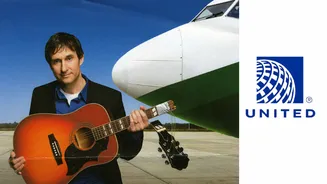

In the history of customer service disasters and viral internet lore, few tales capture the spirit of underdog triumph quite like the saga of Dave Carroll
and his ill-fated Taylor guitar. What began as a routine flight in 2008 escalated into a modern-day David-and-Goliath confrontation, where a humble musician armed with nothing but his wit, a camera, and a catchy tune brought a corporate giant to its knees. This is the detailed story of how a broken instrument sparked a “battle” that cost United Airlines dearly—not just in reputation, but in cold, hard stock market value. While the song is sometimes misremembered by different titles, the true anthem of this rebellion was “United Breaks Guitars,” a protest song that became synonymous with consumer empowerment in the digital age. The Inciting Incident: A Flight to Nowhere Good It all started on March 31, 2008, when Dave Carroll, a Canadian singer-songwriter and frontman of the folk band Sons of Maxwell, boarded a United Airlines flight from Halifax, Nova Scotia, to Omaha, Nebraska, with a layover in Chicago. Like most touring musicians, Carroll travelled with delicate and valuable instruments, including a prized Taylor 710ce acoustic guitar worth around $3,500. While the plane was taxiing in Chicago, Carroll and other passengers looked out the window and saw baggage handlers throwing luggage onto the tarmac. Among the bags were guitar cases. A fellow passenger reportedly shouted that guitars were being tossed around, and Carroll quickly realised one of them was his. The handling appeared careless and rough. Instruments were treated like ordinary cargo, with no regard for their fragility. Carroll knew immediately that the situation would end badly. When he arrived in Omaha and collected his luggage, his fears were confirmed. The guitar’s neck was broken, the body cracked, and the instrument was badly damaged. Repairs would cost nearly as much as replacing it altogether. Carroll approached United staff at the airport but was directed to file a formal claim instead. This marked the beginning of a long and frustrating battle. The Fruitless Fight: Nine Months of Corporate Stonewalling Over the next nine months, Carroll tried repeatedly to get compensation. He made phone calls, sent emails, and contacted multiple airline offices, carefully documenting each interaction. United maintained that damage claims had to be reported within 24 hours at the final destination. Carroll argued that the damage occurred in Chicago, not Omaha, and that multiple passengers had witnessed the mishandling. The airline denied responsibility at every step. Claims were rejected on procedural grounds, and repair estimates provided by the guitar manufacturer made no difference. Eventually, a customer service representative informed Carroll that his claim was denied outright. Exhausted and out of options, Carroll concluded that traditional complaint channels would lead nowhere. The Weapon Forged: “United Breaks Guitars” Takes Flight Instead of pursuing legal action, Carroll turned to what he knew best—music. He decided to write and record a series of songs about his experience and share them publicly. On July 6, 2009, he uploaded a music video titled “United Breaks Guitars.” Shot on a modest budget with help from friends and family, the video humorously retold the incident in a folk-country style. The lyrics were sharp, satirical, and easy to remember. The song was catchy, relatable, and perfectly timed for the rise of social media. Carroll expected modest attention. Instead, the video exploded. Within days, it racked up hundreds of thousands of views, then millions. It spread rapidly across blogs, social platforms, and news media. The chorus became shorthand for airline frustration everywhere. Carroll later released two follow-up songs, but the original remained the most powerful. It eventually crossed tens of millions of views and became a landmark example of viral consumer protest. The Corporate Casualty: Shares Shattered and Lessons Learned As the video gained traction, United Airlines faced severe reputational damage. Within days of the song’s release, the airline’s parent company saw its stock price fall sharply, wiping out an estimated $180 million in market value. While broader market conditions may have played a role, the timing drew widespread attention to the impact of the viral backlash. United initially remained silent, allowing criticism to snowball. When it finally responded, the airline offered Carroll compensation equivalent to what he had originally requested. By then, the moment had passed. Carroll declined personal compensation and suggested a charitable donation instead, which United eventually made. However, the damage to the brand had already been done. The incident went on to become a widely cited case study in crisis management and the power of social media. Aftermath and Legacy: A Tune That Echoes Still Following the viral success, Carroll’s career surged. He received book deals, speaking invitations, and global media attention. His band gained international recognition, and the guitar manufacturer gifted him replacement instruments. United Airlines, meanwhile, revamped parts of its customer service approach and baggage handling procedures. The story became a cautionary example for corporations navigating the digital age. More than a decade later, “United Breaks Guitars” remains a defining lesson in accountability. It demonstrated how one dissatisfied customer, armed with creativity and timing, could force a global corporation to listen. Dave Carroll didn’t just write a protest song—he reshaped how companies think about customer power in the internet era.