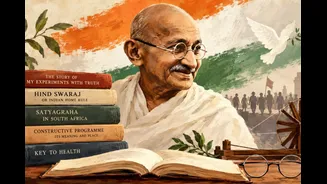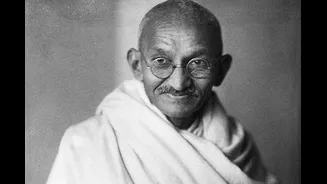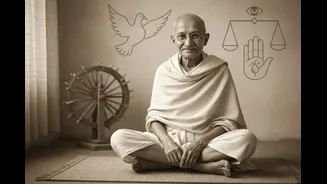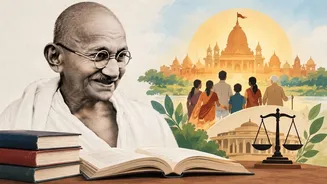









Mahatma Gandhi envisioned the benchmark for effective governance as “Ram Rajya”, rooted in principles of probity, transparency, compassion and welfare,
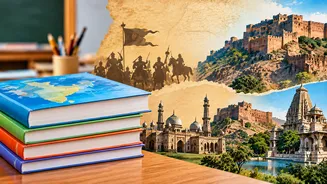
according to a new Class 9 social science textbook prepared by the NCERT, according to a PTI report. Nearly six months following the commencement of the academic session, the NCERT released the second part of the book titled "Understanding Society India and Beyond" on Tuesday (September 30). The initial part was made available in June. The chapter named “Governance and Public Policy” mentions the Sanskrit saying "Prajasukhe sukham rajnah, prajanam cha hite hitam", which translates to "in the happiness of the people lies the happiness of the ruler, and in the interest of the people lies the interest of the ruler". "Mahatma Gandhi visualised 'Ram Rajya' as an ideal model of governance, rooted in probity, transparency, compassion, welfare and people-centric orientation in governance and public policy. Gandhi's views on Ram Rajya reflect the collective imagination of Indians from their distant past to the present day," the textbook read. It depicts Ram Rajya as "one of the best examples of good governance and a good collective life", as shown in the Ramayana and the 16th-century Ramcharitmanas.
Governance As Sacred Responsibility
The textbook referenced the Mahabharata and the Vedic tradition to elucidate the idea that governance involves responsibility and is not just restricted to the exercise of authority.
"From the Vedic period to the Ramayana and the Mahabharata, Indian tradition has consistently viewed governance as a sacred responsibility rather than merely a means of exercising power," the chapter said.
"Good governance was measured not only by the ruler's authority but by the peace, prosperity, justice and well-being in society," it added.
The chapter utilises these references to deliberate on the wider concept of Rajdharma, or the duties and responsibilities linked with righteous governance.
The printed syllabus of the National Council of Educational Research and Training (NCERT) comprises six chapters encompassing history, geography, economics and political science.
(With inputs from PTI)