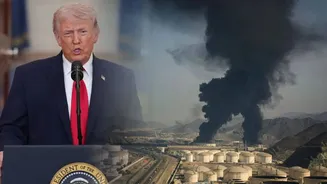






Standing before the American public in a high-stakes primetime address, Donald Trump distilled his Iran policy into a single line: “We’re now totally independent
of the Middle East… We don’t need their oil. We don’t need anything they have — but we’re there to help our allies.” Seemingly, a statement designed to reassure. At a time when the war has pushed oil markets into volatility and domestic fuel prices have surged, Trump sought to frame the conflict not as a resource-driven war, but as a strategic obligation — one rooted in alliances and security rather than dependence.
🇺🇸
— SilencedSirs◼️ (@SilentlySirs) April 2, 2026
“We don’t need the Middle East.”
Trump says the U.S. is now independent—
no need for oil,
no need to stay…
just there to “help.” pic.twitter.com/wPCR57FQok
War Continues Even As Dependence Is Denied
Yet even as Trump underscored independence, he made it equally clear that the war was far from over. He said US forces would continue operations for another “two to three weeks” to “finish the job”, framing the campaign under Operation Epic Fury as nearing its decisive phase. In doing so, he repeated sweeping claims about Iran’s military degradation, stating that its “navy is gone” and its “air force is in ruins”.
Trump on Iran: "We are going to hit them extremely hard over the next 2–3 weeks. We are going to bring them back to the Stone Ages, where they belong."
— AZ Intel (@AZ_Intel_) April 2, 2026
(Reposted to correct clip) pic.twitter.com/jt91tK1lCa
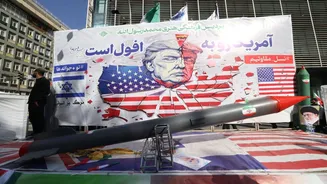
The conflict itself traces back to the US-Israeli strikes that led to the killing of Ayatollah Ali Khamenei, an event that dramatically escalated tensions and reshaped the regional balance. But beyond the short-term timeline, the address offered little clarity. There was no defined end-state, no clear diplomatic pathway, and no indication of what “completion” would ultimately look like.
The Contradiction At The Centre
What emerged from the speech was a tension that has increasingly come to define the war. If the United States does not need Middle Eastern oil, why remain so deeply engaged militarily in the region? Trump’s answer lay in alliances. He framed the war as support for partners such as Israel and Gulf states, positioning the US as a stabilising force rather than a dependent actor.
However, the distinction has not entirely resolved the contradiction. The United States may be less reliant on Middle Eastern energy than before, but global oil markets remain interconnected. Disruptions in the Gulf continue to drive price volatility — a reality that American consumers are already feeling.
A Speech Shaped By Domestic Pressure
The tone of the address cannot be separated from the political climate in Washington. Recent polling has shown Donald Trump facing declining approval, particularly on economic performance. His economic favourability has dropped to around 31%, with broader approval ratings also trending downward.
At the same time, rising fuel costs — a direct consequence of instability linked to the Iran conflict — have intensified pressure on the administration ahead of the mid-term elections. Against that backdrop, the speech appeared as much about managing perception at home as it was about signalling resolve abroad.
Strength Without A Clear Exit
Trump reiterated that the United States would “finish the job” once its “core strategic objectives” were achieved. But those objectives were described in broad terms — dismantling Iran’s capabilities, neutralising threats, and stabilising the region.
What remains unclear is how success will be measured. Military claims of degradation, even if partially accurate, do not automatically translate into strategic closure. Conflicts of this nature often extend beyond battlefield metrics, especially when regional actors, proxy networks, and economic variables remain in play.
Between Messaging And Reality
At its core, the address attempted to project control — over the war, over markets, and over public sentiment. But it also revealed the balancing act confronting the administration. On one hand, there is the assertion of strength and independence: that America no longer needs Middle Eastern oil and can act purely on strategic terms.
On the other, there is the reality of continued military engagement, economic ripple effects, and political pressure at home. For now, the administration insists the war is approaching its end. But without a clearly defined exit, the line — “we don’t need their oil” — risks becoming less a statement of fact and more a test of how long the current strategy can be sustained.