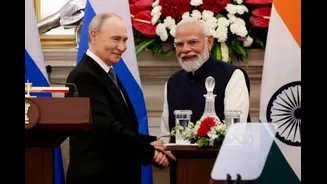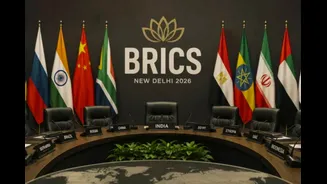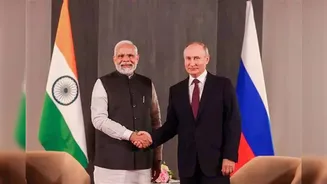







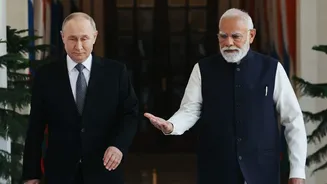
At the BRICS Summit, India and Russia are expected to look beyond an economic relationship increasingly driven by crude oil, with Russian President Vladimir
Putin’s New Delhi visit likely to put trade diversification, defence co-production, investment and local-currency payments in focus. However, given India’s Russian crude imports worth nearly $48 billion in FY26, is a meaningful shift beyond oil truly possible? Dr Pralok Gupta Professor and International Trade Expert, Centre for WTO Studies, IIFT told Times Now Digital, "beyond oil, there are significant complementarities and scope for enhanced investment from Russia to India, particularly in defence, mining, and infrastructure sector, and India’s exports of pharmaceuticals, chemicals and agri products to Russia." Experts believe a long-term economic engagement will require a more diversified partnership. Dr Jaijit Bhattacharya, President, C-DEP Research said, "oil has provided the foundation for recent growth in India-Russia trade, but long-term economic engagement requires moving towards a more diversified partnership. The future of bilateral ties lies in co-development of technologies, defence manufacturing, critical minerals, pharmaceuticals, and energy cooperation. The priority should be converting strategic trust into commercial linkages that create value for both economies. In addition, we need to find a solution to the Rupee-Rouble issue, where Russian entities have ended up accumulating large amounts of Rupee." Economists also believe resolving structural bottlenecks is the need of the hour. Mitali Nikore, Founder & Chief Economist, Nikore Associates said, "while crude oil has dominated recent India-Russia trade expansion, moving toward a balanced $100 billion bilateral target requires diversifying into high-value manufacturing and consumer goods. Realistically, India’s immediate export growth can be driven by pharmaceuticals, agricultural products, electronics components, auto parts, and specialized engineering goods where Russia faces supply chain constraints. Addressing the severe trade asymmetry, however, hinges on resolving structural bottlenecks—specifically expanding local currency settlement mechanisms, establishing seamless national payment interoperability, and streamlining non-tariff and customs clearances. A sustainable roadmap lies in moving beyond simple commodities trading toward joint industrial ventures, services exports, and mobility of skilled Indian labor in tech and healthcare, transforming a resource-heavy relationship into a broad-based economic partnership."