






What is the story about?

The dreaded "0% battery" is the ultimate nightmare for any Indian EV owner especially when you are stuck in a bumper-to-bumper crawl on a flyover or in the middle
of a monsoon downpour. Whether you drive a Tata Nexon EV or an MG ZS, for a long time, I wondered if the car would just shut off like a light bulb, leaving me stranded. After looking into the actual mechanics and the current state of EV Roadside Assistance in India, I realised that modern cars are designed to enter a specific "Turtle Mode" fail-safe. While it’s a stressful situation, these systems ensure you aren't caught completely off-guard.
The ‘Turtle Mode’ Reality
In India, popular models like the Tata Nexon EV or the Punch EV don’t just die instantly. However, in the May-June heat, some owners do report a sudden battery drop from 10% to 0% due to thermal stress. When you hit that critical low, the car enters "Turtle Mode" (or Limp Mode). During this phase, your real-world range becomes the priority: the AC usually cuts out, and your speed is capped at about 50-55 km/h. This is a deliberate safety feature which is designed to help you crawl out of a "bumper-to-bumper" flyover jam and pull over before the high-voltage system shuts down.Why You Should Never ‘Standard’ Tow In India
If the car finally hits true zero, the most critical thing I discovered is that you cannot—and should not—allow a local mechanic to "toe-chain" or wheel-lift your EV. Most Indian EVs use regenerative braking systems where the motor is always connected to the wheels. If you tow it with the wheels on the ground, the motor will spin, generate electricity, and potentially overheat or fry your battery because the cooling system is off. In India, you must specifically demand a flatbed tow truck from your Roadside Assistance (RSA) to ensure all four wheels are off the ground.Also Read: EVs Need More Than Charging - India, EU Now Target Battery Recycling

The Rise of Mobile Charging Units
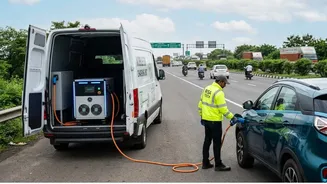
The good news for us is that Roadside Assistance (RSA) in India has evolved. Many manufacturers and insurance providers offer "Mobile EV Charging" in cities like Delhi, Mumbai, Kolkata, Chennai, Pune, Hyderabad and Bengaluru. Instead of a tow, a specialised van equipped with a portable fast charger can reach you and give you enough "top-up" (usually 10–15%) to reach the nearest public charger. It’s a relief to know that even at 0%, the "buffer" in the battery usually keeps your hazard lights and basic electronics working long enough for help to arrive.Ultimately, hitting 0% isn’t the disaster it’s made out to be. Between "Turtle Mode" and the availability of flatbed RSA in India, you are never truly stranded without options. The key is to stay calm, pull over safely and let the tech do its job. As our charging infrastructure grows, this "range anxiety" can soon be a thing of the past.