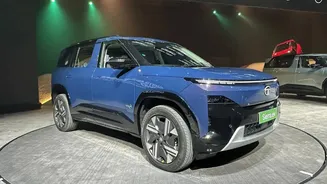











The Tata Sierra EV has been launched in India at an introductory price of Rs 18.79 lakh (ex-showroom), marking a new chapter for the OG nameplate that
embraces an electric avatar for the very first time. It is followed by the ICE-powered version that returned to showrooms last year. As expected, the Sierra EV comes with two battery pack options: 63kWh and 75kWh. The SUV is also the second, after the electrified Harrier, to get a QWD (Quad Wheel Drive) system. This capability is not yet available on the ICE Sierra. The electric Tata SUV is also based on the brand's ‘Acti.ev’ architecture. Bookings for the EV are now open, while deliveries are slated to commence from July 15, 2026 onwards. Read on to know more about Tata Sierra battery, range, and other features.
Tata Sierra EV Design
The core design of the electric Sierra is close to that of the ICE one, albeit with a few EV-specific changes. The most significant of which you can see in the sealed body-coloured panel. A full-width LED DRL strip runs across the nose, and the headlamps are mounted lower on the bumper. There are also silver skid-plate elements for enhancing the sturdy look. The side profile keeps the Sierra's glasshouse and signature rear quarter window, though the alloy wheels have seen a new aerodynamic design. Tata has given connected LED taillamps to the electric SUV, a feature that is very common to see in modern cars today. The look is completed with a muscular bumper.Tata Sierra EV Interior And Features
Inside, the Sierra EV breaks from the rest of the range. It comes with a new ivory colour scheme. A panoramic sunroof adds to the upmarket feel, while a four-spoke steering wheel with an illuminated Tata logo gives the electric Sierra a modern touch. There's a triple-screen setup spanning the dash, consisting of an infotainment touchscreen, a digital instrument cluster and a dedicated screen for the front passenger. The EV packs a wide spectrum of advanced features, including a premium JBL audio system with Dolby Atmos support, a head-up display with four display modes, ventilated and powered front seats, Android Auto, dual-zone climate control, and wireless Apple CarPlay. It also gets a dedicated Boost Mode and six terrain modes, a 540-degree camera that provides a bird's-eye view along with an underbody display, Boss Mode, a digital key, and low-speed cruise control. The Tata Sierra EV offers 622 litres of boot space (measured to the roof) and a 55-litre front trunk (frunk). It is important to note that the feature list varies, depending on the selected variant.
The Sierra EV also comes equipped with a 360-degree camera, six airbags, electronic stability control, front and rear parking sensors, Level-2 ADAS, and a tyre-pressure monitor, Park Assist, and Summon Mode.
Tata Sierra EV Battery, Range and Charging
The Sierra EV can be had with either a 63kWh or a 75kWh battery pack. A rear-wheel-drive setup is standard, while the 75kWh version is also available with a dual-motor AWD system. Tata claims that the smaller battery can offer a C75-certified range of 440-460 kilometres, while the larger one could deliver 510-530 kilometres. The Sierra EV boasts an MIDC-certified range of up to 665 kilometres in its 75kWh guise. In comparison, models powered by the smaller 63kWh battery offer a claimed range of up to 565 kilometres. The electric SUV supports 3.3 kW portable, 7.2 kW home, and 120 kW DC fast charging. The fast charging option can battery can charge the battery from 20% to 80% in 26 minutes. Tata has equipped the Sierra EV with an illuminated charging port that communicates its status through colour-coded LEDs. Red denotes a fault, white indicates charging has started, blue shows the charging process is ongoing, and green confirms completion. The SUV also offers 3.3 kW V2L and 5 kW V2V charging capabilities. It has a 0 to 100km/h acceleration time of 5.8 seconds (In boost mode). Moreover, the EV can gain up to 250 kilometres of range within 15 minutes.
The SUV utilises a dual-motor setup, with the front motor generating 103kW (138hp) of power and 164Nm of torque, and the rear motor providing a more robust 175kW (235hp) and 340Nm of torque.