





What is the story about?

The 2026 Tata Tiago EV has arrived at Rs 6.99 lakh (ex-showroom) — making it the cheapest five-seat electric car in India right now. The only car it is
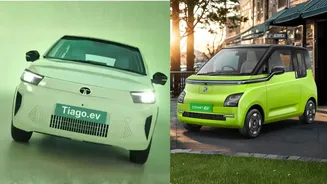
directly fighting at this price is the MG Comet EV Executive at Rs 7.62 lakh (ex-showroom). Both are aimed at budget-conscious first-time EV buyers, but sitting them side by side makes one thing clear — they are built for completely different use cases. One is a regular hatchback, the other is a city-only micro car. Which one makes sense for you comes down to one honest question: how are you actually going to use it?
What the Numbers Say and What Each Car Actually Brings
The Tiago EV base variant runs a 19.2 kWh battery with an electric motor making 61 hp and 110 Nm. Tata's claimed range is 226 km. The Comet uses a smaller 17.3 kWh pack, 42 hp, 110 Nm, and claims 230 km of range — marginally more despite the smaller battery. Both are manufacturer figures. Real-world numbers in Indian traffic with the AC on will be lower on both cars. That is just how it works.The size gap between them is the most important thing to understand. The Tiago EV is a proper five-seat hatchback — familiar dimensions, four doors, seats the whole family. The Comet is a four-seater micro car — shorter, narrower, taller — built specifically for city streets. In dense traffic and tight parking, the Comet is genuinely easier to live with. The upright stance, wide glass area, and small turning circle are not styling decisions — they are practical tools for urban India.
On safety and features, neither car dominates cleanly at the entry level. The Tiago EV base variant gets six airbags, traction control, drive modes, regenerative braking, TPMS, a digital cluster, and climate control. The Comet's entry variant gets power windows, electrically adjustable ORVMs, and Bluetooth audio with steering controls — things the base Tiago EV does not offer. Both have gaps. Neither is complete on its own at this price.

What Each Car Is Actually Better At
The Tiago EV is the more versatile of the two — no question. It seats five, drives like a normal hatchback, handles a mix of city and highway use, and brings a stronger safety package at a lower price than the Comet. If you need one car that does the school run, the office commute, the occasional weekend trip, and carries four adults without anyone sitting sideways — this is the one.The MG Comet is not trying to do any of that. It is built for short, predictable city routes where parking is painful and lanes are narrow. On those specific terms, it works well and it does not apologise for what it is. The entry variant also brings a few everyday convenience features the base Tiago EV skips — so at Rs 7.62 lakh, it is not without a case to make for the right buyer.
The simplest way to frame it: if this is going to be your household's only car, the Tiago EV is the more sensible pick. If you already have another vehicle and this is purely for city commuting, the Comet is worth a serious look.
The Bottom Line — Who Should Buy Which
If you need one car that does everything — city runs, occasional highway trips, five people — the Tiago EV is the better deal on paper. More space, stronger safety spec, lower price. The ownership experience questions are real but not guaranteed.If your driving is almost entirely urban, you log low daily kilometres, and you have another car in the household for longer trips — the Comet makes a genuine case for itself. It is not a compromise in the city. It is actually well-suited to it. The choice here is less about which car is objectively better and more about being honest about what your daily routine actually looks like.