




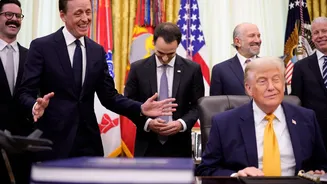
United States President Donald Trump has indicated that a decision on launching fresh military strikes against Iran may not be taken until next year, signalling a possible extension of the timeline for
Washington’s next move in the ongoing conflict.
Asked by Reuters about the possibility of renewed strikes against Tehran, Trump said, “Well, I’ll talk to you about it after the beginning of the year.”
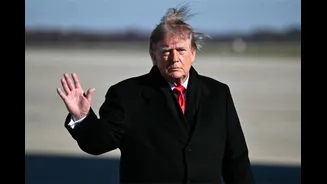
“We’ve got time,” he added while speaking aboard Air Force One as he returned to Washington from his China trip on Thursday.
Trump offered similar timelines in two other interviews, suggesting that he was in no hurry to decide on the next course of action.
“We’ll see what happens after January 1,” he told Fox News in an interview aired on Thursday. In a separate conversation with a reporter from Axios and Israel’s News 12, he said, “I’m not rushing to make any decisions on Iran.”
Is Trump Reconsidering His Iran War Strategy?
His latest remarks mark a shift from his earlier indications that developments in the eight-month conflict could reach a turning point after the November 3 US midterm elections.
Trump had repeatedly suggested in the run-up to the polls that Tehran could become more amenable to a negotiated settlement once the elections were over.
However, following Republican losses in both chambers of Congress, the Trump administration said last week that it believed its blockade and economic sanctions were exerting pressure on Iran.
The US Senate, where Republicans retain control until January 3, on Thursday once again rejected a resolution seeking to limit the war.
Iran War A Factor In Republicans’ Midterm Setback, Trump Admits
Trump has acknowledged that the conflict with Iran contributed to his party’s electoral setbacks, but maintained that he would not have made a different decision.
Vice President JD Vance, who is seen as a potential contender in the 2028 presidential race, had publicly distanced himself from the conflict, citing it as one of the factors behind the Republicans’ poor electoral performance.
Trump subsequently redirected Vance from diplomatic efforts concerning Iran towards domestic priorities.
Responding to a question about Vance’s social media remarks, Trump told Reuters, “JD was fine,” adding, “What he said was right. He said that the whole situation is one of the reasons certainly that the election didn’t go our way.”
Trump, however, reiterated his justification for the military campaign, saying, “And the big thing is if you had to do it again, would you do it? And the answer is yes. Because you can’t let Iran have a nuclear weapon.”
Meanwhile, the joint statement released after Trump’s summit with his Russian and Chinese counterparts on Thursday made no reference to the conflict with Iran.
Trump Downplays Report Of Iranian ‘Dirty Bomb’ Threat
Separately, Trump sought to play down a CNN report suggesting that Iran was planning to detonate a “dirty bomb” in Washington. Such a device uses conventional explosives to disperse radioactive material.
Asked by Fox News whether residents of the US capital should be concerned, Trump responded, “I don’t think so.”
However, he also claimed that there were indications that Tehran was exploring biological and chemical weapons, without providing further details.
“There is indication that Iran is looking at gases, looking at bio, because we’ve shut them out with the nuclear. Nuclear is much harder. And they’re looking at gas and … biological weapons — not nice — and other things,” Trump said.
Iran rejected the allegations, with its Foreign Ministry saying in a post on X that American claims about Tehran pursuing chemical and biological weapons were designed to spread fear and provide justification for military action. Tehran had also dismissed the CNN report earlier this week as “baseless.”
The United States, Israel and several other Western nations have for years accused Iran of pursuing nuclear weapons capabilities. Tehran has consistently denied seeking to develop an atomic bomb.
The destruction of Iran’s nuclear programme was among the principal reasons Trump cited when he ordered military strikes against the country in February, alongside Israel.
With inputs from Reuters