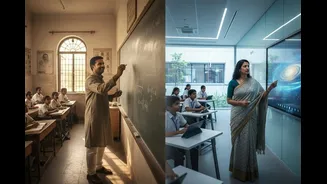







As India observes Teachers’ Day on September 5, the evolution from chalkboards to AI offers a glimpse into how dramatically education has changed. The transformation is visible not only in classrooms but
also in the tools teachers use, the skills that teachers are expected to develop and the role they play in students’ learning journeys. While the teacher remains at the centre of education, technology has increasingly become an important part of the teaching-learning process.
For decades, lessons largely followed a teacher-led model, with educators explaining concepts on the board while students took notes and referred to textbooks. In the recent past, classrooms began incorporating projectors, computers, audio-visual material and eventually interactive or smart boards.
The COVID-19 pandemic dramatically accelerated India’s transition towards digital education. With schools had to be shut down for prolonged periods owing to children’s’ safety, physical classes were disrupted. Schools and teachers had to turn to video classes, online assignments, messaging platforms and digital resources to maintain learning continuity.
Eventually, when schools reopened, blackboards were replaced by computers, projectors, digital content and online learning platforms.
Teachers nowadays are increasingly required to understand digital tools, create or select online learning material, conduct digital assessments and adapt lessons for students with different learning needs.
How teaching looked like over the past few decades?
1950s: Blackboard, textbook and chalk — the teacher was the primary source of knowledge.
1970s: Blackboard and chalk continued to dominate classrooms, with written examinations taking the centre stage.
1980s: Radio and educational television began bringing technology into lessons.
1990s: Computers slowly entered classrooms and introduced teachers to digital teaching aids.
2000s: Projectors, multimedia and smart classrooms began supplementing the blackboard at a few schools.
2010s: Chalkboards paved the way for Internet, YouTube and digital learning platforms.
Through 2021 to 2025, blended learning became more common, combining physical classrooms with digital resources.
According to the National Education Policy (NEP) 2020, teachers and faculty are “the heart of the learning process – their recruitment, continuous professional development, positive working environments and service conditions.”
However, the teaching-learning process has changed. The traditional classroom often followed a common pace for an entire class. Technology has made it easier to provide additional material to students who need more support while allowing others to explore topics in greater depth.