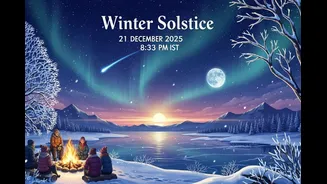

Winter Solstice 2025 arrives today, bringing the shortest day and longest night in the Northern Hemisphere, marking the official start of astronomical winter. While meteorological winter officially began
on December 1, some prefer to wait for the solstice before considering winter truly underway, according to BBC. The winter solstice marks the shortest day and the longest night in the Northern Hemisphere, signalling the start of astronomical winter. The solstice is in fact not an entire day but a precise moment.
Winter Solstice 2025: Date And Exact Time
According to USA Today, the Northern Hemisphere’s astronomical winter will officially begin with the winter solstice at 10:03 a.m. EST on Sunday, December 21, 2025 (8:33 p.m. IST).
This marks the point when the Northern Hemisphere is tilted farthest away from the Sun. The date of the solstice can occur anytime between December 20 and 23, though it most commonly falls on December 21.
Winter Solstice 2025: What Happens
Winter solstice marks the moment when the Sun appears to pause in its movement across the sky before reversing direction.
During this event, the Sun is positioned directly above the Tropic of Capricorn, the southernmost latitude it reaches each year. As a result, the Southern Hemisphere experiences its longest day and shortest night. In contrast, the Northern Hemisphere receives the least amount of sunlight, leading to the shortest day and longest night of the year.
Solstices occur because the Earth is tilted on its axis by about 23.5 degrees, according to BBC. This tilt determines which part of the planet receives the most direct sunlight at different times of the year, shaping the changing seasons.
What Is The Opposite Event Of The Winter Solstice?
The opposite of the winter solstice is the summer solstice. After the winter solstice, the Sun gradually begins its northward journey relative to the equator. This movement continues for about six months. This culminates in the summer solstice, when the Sun reaches its most northerly position directly above the Tropic of Cancer.
Summer solstice marks the start of astronomical summer and is the point at which the Sun sits highest in the sky, bringing the longest day and shortest night of the year to the Northern Hemisphere.
Between these two solstices lie the equinoxes, which occur in March and September. During an equinox, the Sun is positioned directly above the equator, resulting in nearly equal lengths of day and night across the globe. These events signal the beginning of spring and autumn in the Northern Hemisphere.
Winter Solstice 2025: Astronomical And Cultural Significance
Astronomically, the winter solstice is not the day with the latest sunrise or the earliest sunset. Instead, it marks the moment when the Sun appears at its lowest point in the Northern Hemisphere sky and reaches its farthest position south.
The solstice also highlights a key scientific reality. That the changing seasons are caused by the Earth’s axial tilt, not its distance from the Sun, even though the planet is actually closest to the Sun in January, PBS News reported.
Beyond its astronomical significance, the period leading up to the winter solstice has long been viewed not merely as a time of hardship, but of renewal and hope. Across cultures, the solstice has carried deep symbolic meaning.
Indigenous communities in North America observed the solstice through ceremonies and solar-aligned structures such as Cahokia, reflecting sophisticated astronomical knowledge and a belief in the interconnectedness of the world.
Elsewhere, traditions took different forms, including the Persian festival of Yalda, when families stayed awake through the longest night to welcome the return of light at dawn.
The solstice also found expression in architecture, as noted by PBS News. Ruben Mendoza, an archaeologist at California State University, Monterey Bay, discovered that in many Spanish colonial-era mission churches, the winter solstice triggers a rare event in which a beam of sunlight enters the building and illuminates a central religious object, such as an altar, crucifix or saint’s statue.