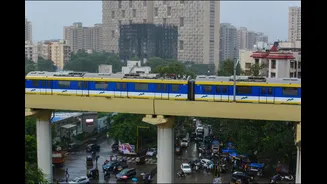

Mumbai Metro-9 is set to be operational next month, Maharashtra Transport Minister Pratap Sarnaik said on Monday.
The line 9 will connect Dahisar East in Mumbai to Mira-Bhayandar in Thane district.
Which areas will Mumbai Metro-9 cover? How will it boost connectivity?
Mumbai
Metro Line 9 spans approximately 13.58 km with 11.386 km elevated and 2.195 km underground, as part of the Red Line connected to Metro Lines 7 and 7A. Its stations will be Dahisar East, Pandurang Wadi, Miragaon (Amar Palace), Kashigaon (Zankar Company) (Thane district), Sai Baba Nagar Meditiya Nagar (Deepak Hospital), Shahid Bhagat Singh Garden (Maxus Mall), Subhash Chandra Bose Stadium, MBMC Sports Complex, Indralok Station. It connects to Metro 7 (Dahisar East to Andheri East), Metro 2A (Dahisar West to DN Nagar), with future extensions connecting to Metro 3 (Colaba-Bandra-SEEPZ underground). While phase 1 (Dahisar-Kashigaon) opened by end of 2025, the full line is projected to be completed by late 2026. The Metro will mean a fast, reliable transit option for Mira Bhayandar residents, especially via Dahisar East and interchanges. Smooth interchange at Dahisar East enables quick access to Andheri, Bandra, and south Mumbai. Mira Road to Andheri commute, which currently takes 1.5 hours by road, may take under 50 minutes using Metro 9-7-2A. It will reduce dependency on cars, buses, and private vehicles especially for commuting to Andheri, the airport, South Mumbai etc.
Progress in Motion: Trial Run of Mumbai Metro Line 9!
Flagged off the ‘Trial run of Phase-1 of Mumbai Metro Route-9, from Kashigaon to Dahisar (East)’ of the Mumbai Metropolitan Region Development Authority at Mira Bhayandar, Thane.
The section of Metro Line 9 from Kashigaon to… https://t.co/90cHK4Wy6a pic.twitter.com/Hi4x4y6fGk
— Devendra Fadnavis (@Dev_Fadnavis) May 14, 2025
WEH vs Mumbai Metro-9: What do numbers say?
The WEH sees 2.2 million to 3 million vehicles per day at certain points. The Mumbai Metropolitan Region Development Authority (MMRDA) has projected 8.47 lakh passengers daily for Mumbai Metro-9, saying the number is likely to go up to 11.12 lakh daily by 2031. The Metro-9 line is expected to reduce the travel time by 50 75%, depending on road conditions.
Thane District Gets Its First Metro: Trial Run of Metro Line-9 Phase-1 Commences
Metro Line-9, Connecting Mira Bhayander to Western Suburbs, eastern Suburb and International airport
In a historic development for the Mumbai Metropolitan Region (MMR), the trial run of Phase-1 of… pic.twitter.com/Yp19NBF8JZ
— MMRDA (@MMRDAOfficial) May 14, 2025
How will the Mumbai Metro-9 decongest Western Express Highway (WEH)?
Alternative to road commute: Residents of Mira Bhayandar and surrounding suburbs are largely dependent on the WEH or other roads to reach Mumbai. Once the Metro 9 line is operation, a major chunk would shift from personal vehicles or buses to Metro. This is expected to reduce the load during peak hours.
Dahisar toll naka bottleneck: This one spot is notorious for traffic snarls. If commuters have Metro-9 for their journey, they could bypass this spot, giving respite to themselves and even the traffic bottleneck.
Reduced travel time: According to the Mumbai Metropolitan Region Development Authority (MMRDA), the line would bring down the travel time by 50 75%. This would also reduce pollution.
Integration & interchanges: The interchanges at Dahisar East and Miragaon mean people can switch between metro lines instead of driving all the way.
Double-decker structure and flyover: The line has an innovative design – a part of the corridor uses a double decked bridge (metro on upper deck, vehicular flyover on the lower deck). This will ensure optimal use of space and possibly manage traffic flows better in constrained areas near WEH.
Will Mumbai Metro-9 fix all WEH problems?
Not all commuting issues will be solved by the Mumbai Metro-9 alone. It will also require efforts such as feeder services, buses, autos at stations, commuters’ shift to the line, among others.