






Tamil Nadu’s post-election political drama has all the elements of a blockbuster suspense thriller. Everyone’s watching it with great interest and no one can really so far figure what’s going to be the end
of this film. This high-intensity political drama is now entering constitutional grey territory.
Check live updates on Tamil Nadu government formation here
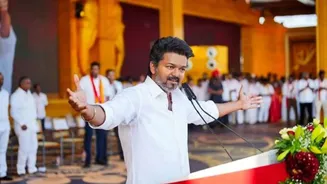
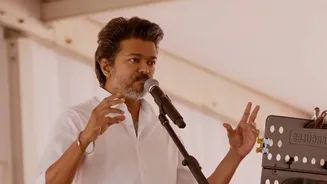
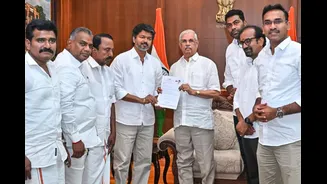
More than 72 hours after the fractured mandate threw up a hung Assembly, no party has been able to cross the majority mark of 118 in the 234-member House. Actor-politician Vijay has twice met Governor Rajendra Vishwanath Arlekar to stake claim, but Raj Bhavan has so far refused to invite him to form the government, saying the required numbers have not been demonstrated.
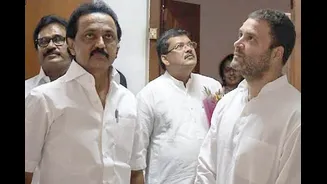
At the same time, Tamil Nadu politics has been rocked by rumours of an unprecedented possibility of an understanding between arch-rivals MK Stalin and Edappadi K Palaniswami, with around 20 AIADMK MLAs currently stationed at a Puducherry resort amid intense speculation over possible realignment.
TVK leaders, meanwhile, have escalated the pressure dramatically. Party MLAs have publicly warned that all 107 elected legislators are prepared to resign if a “backdoor DMK-AIADMK arrangement” is installed instead of allowing the single-largest party to attempt government formation.
What happens if nobody can form a government? Can Tamil Nadu actually face a fresh election within weeks? And how long can the Governor wait? The answer lies in a mix of constitutional provisions, Supreme Court rulings and political convention.
What The Constitution Says
The Constitution does not prescribe a fixed deadline within which a government must be formed after election results. Under Article 164, the Governor appoints the Chief Minister. But convention and court rulings make one principle clear: the Governor must identify the person most likely to command majority support in the Assembly.
That support must eventually be tested on the floor of the House, not merely through letters or political claims.
This principle was firmly reinforced by the Supreme Court in the landmark SR Bommai v Union of India case, which held that majority must ordinarily be proven through a floor test.
In Tamil Nadu’s case, Raj Bhavan has so far maintained that Vijay has not demonstrated support from 118 MLAs.
Why Vijay Has Not Yet Been Invited To Form Govt
The TVK emerged as the single largest party with 108 seats, still 10 short of the majority mark. Congress has extended support, but even with that backing, the numbers remain insufficient.
Some reports say the Governor specifically asked Vijay whether his confidence about reaching the majority mark was based merely on assumptions that smaller parties would eventually support him.
According to Lok Bhavan’s official communication, the Governor conveyed that “the requisite majority support in the Tamil Nadu Legislative Assembly, essential for forming the government, has not been established.”
The TVK, however, has insisted the single-largest party deserves the first opportunity. The party has also accused both DMK and AIADMK of attempting to “subvert the mandate through post-poll arithmetic”.
What DMK and AIADMK Are Saying
Publicly, the DMK has not confirmed any alliance talks with AIADMK.
But internally, the party has clearly signalled that preventing another election is becoming a priority. A DMK legislature party resolution empowered Stalin to take “immediate decisions” to ensure a stable government in the state. According to party insiders, Stalin has conveyed that Tamil Nadu should avoid “prolonged instability” and another expensive election cycle.
AIADMK chief EPS, on the other hand, has remained deliberately cautious in public, neither endorsing nor completely dismissing rumours of possible coordination with DMK legislators. His decision to move MLAs to a Puducherry resort has only intensified speculation. Sources close to AIADMK say the party fears poaching attempts amid the deadlock.
Can The Governor Keep Waiting Indefinitely?
The shortest answer to this is no. While the Constitution does not provide a fixed time limit, the Supreme Court has repeatedly held that constitutional authorities cannot allow indefinite uncertainty.
Governors are expected to act within a “reasonable timeframe”.
In past political crises across states like Maharashtra, Karnataka and Goa, courts have ordered floor tests within 24 to 72 hours once competing claims emerged.
But Tamil Nadu’s situation is more complicated because no formation has yet crossed the halfway mark convincingly.
That leaves the Governor with three broad options:
Invite Vijay Anyway
The Governor could still invite TVK to form a minority government and ask it to prove majority on the floor within a few days. This is what Congress and Left parties are demanding.
Explore Alternative Coalitions
If another bloc, including a possible DMK-AIADMK understanding, presents a stable majority on paper, the Governor can invite that grouping instead.
Recommend President’s Rule
If no stable formation emerges, the Governor can send a report to the Centre recommending action under Article 356. That would place Tamil Nadu under President’s Rule.
But that would not necessarily mean immediate re-election.
President’s Rule is often used as a temporary bridge period when government formation fails.
During this phase, the Assembly may be kept in suspended animation, parties can continue negotiations, and alternative coalitions may still emerge.
Fresh elections happen only if all coalition possibilities collapse, no party can prove majority, and the Assembly is eventually dissolved.
In other words, re-election is the last constitutional option, not the first.
Could Tamil Nadu Actually See Fresh Polls?
While a re-election is constitutionally possible, almost every party appears wary of it politically.
The DMK has suffered heavy losses. The AIADMK remains weakened. And despite emerging as the largest party, TVK may not want to immediately risk another statewide contest without first testing whether momentum converts into a clearer majority.
That is why the current pressure from several parties is centred around one idea: allowing somebody to prove majority on the Assembly floor first.
What Happens Next?
The next 48-72 hours could decide Tamil Nadu’s political future.
If Vijay somehow gathers additional support, Raj Bhavan may still permit a floor test. If a surprise DMK-AIADMK arrangement materialises, Tamil Nadu could witness one of the most extraordinary political realignments in its history.
And if neither side reaches 118, the state could move towards President’s Rule, with fresh elections becoming a real possibility later.
For now, Tamil Nadu remains suspended between mandate, mathematics and constitutional procedure.