







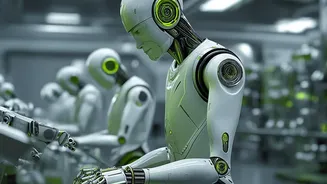
Artificial intelligence was expected to create new industries, open up employment opportunities and make workers more productive. Yet, as 2026 draws to a close, companies are offering buyouts, restructuring
teams and announcing job cuts even as they invest heavily in AI. Microsoft’s latest voluntary exit offer, reportedly open to around 60,000 eligible employees across selected teams in the US, India, Canada and the UK, highlights this contradiction: while AI is expected to create new roles, it could also make some existing jobs redundant.
The trend extends beyond technology companies. Banks, manufacturers and other businesses are reassessing their workforce requirements as automation and AI become part of their operating strategies. But does this mean AI is already eliminating jobs on a massive scale, or are companies using the technology alongside cost-cutting and restructuring to reshape their workforces?
“Every technological shift in history has forced organisations to reshape their workforce. Today, AI adoption, cost discipline and restructuring are happening together because they are closely linked. Companies are realigning teams around new capabilities, retraining people where they can and letting go of roles that no longer fit the model. Reskilling and redeploying talent is now a core mandate for leadership, not an option. The organisations that manage this transition thoughtfully, with transparency and investment in their people, will come out stronger,” said Saakar Yadav, Founder and Managing Director, Lexlegis.ai.
How Many Jobs Have Been Cut So Far?
Tech companies had laid off 134,917 employees across 328 companies as of October 21, 2026, according to Layoffs.fyi. That is already higher than the 122,606 job cuts recorded by the tracker for the whole of 2025, averaging around 459 tech jobs lost every day this year. And more cuts are in the pipeline.
Microsoft has offered buyouts to roughly 60,000 employees, equivalent to about 27% of its workforce. Barclays and American Express have also announced job cuts in the past week, citing AI as one of the reasons. However, the 60,000 figure does not mean that all those employees will leave. When asked how many might accept the offer, a Microsoft spokesperson pointed to similar programmes at other technology companies, which recorded uptake of 3%-5%. If that rate holds, around 1,800 to 3,000 employees could leave.
Microsoft had about 223,000 employees at the end of June, 5,000 fewer than a year earlier. In July, it cut around 4,800 jobs, mostly in its Xbox division, following more than 15,000 layoffs in 2025. Meanwhile, the company has projected total spending of $145.3 billion for fiscal 2026, much of it directed towards data centres.
“There is a difference in what Microsoft is doing and what others are doing. This is misunderstood in the market right now. Microsoft is planning their capacity for the future, and assessing how much capacity they need to deliver outcomes for tomorrow. The participating teams are those that have clearly identified what part of work can get automated, and where do we need human input. This is evident from the teams that have been excluded in this process such as sales, marketing, engineering that are still critical and cannot realise efficiencies with AI,” said Ankur Dhingra, CEO, ProHance.
Barclays plans to cut around 5,000 jobs, or roughly 5% of its workforce, by the end of the year. About 1,000 roles have already been eliminated. The bank said 60% of the planned cuts involve support functions, “including fewer developers as AI makes our people more productive”.
However, CEO CS Venkatakrishnan has cautioned against attributing all the efficiency gains to AI. He said most of the improvements so far have resulted from years of investment in technology and efforts to simplify processes. “AI is the icing on the cake, not the cake,” he said.
American Express plans to cut around 5% of its workforce, equivalent to approximately 3,500 jobs, and has recorded a restructuring charge of $336 million. CFO Christophe Le Caillec said the move aims to make the company “leaner, more agile, and also to prepare for AI”. Amex has not said that AI is replacing the roles being eliminated. The cuts were announced even as the company raised its 2026 forecast.
Apple also seriously considered replacing around 5,000 AppleCare employees with AI around July, according to Bloomberg’s Mark Gurman. However, that plan has since been cancelled.
Standard Chartered plans to eliminate more than 15% of its back-office roles by 2030, amounting to around 7,800 positions. Its operations in Chennai and Bengaluru are understood to be among the areas most affected. CEO Bill Winters acknowledged the shift towards automation, saying, “We do have job role reductions in favour of the machines.”
HSBC is reportedly considering deep cuts to its middle and back offices, with as many as 20,000 positions potentially at risk over time, according to Bloomberg. CEO Georges Elhedery has acknowledged that AI will reshape employment, saying, “We all know generative AI will destroy certain jobs and will create new jobs.”
Indian IT companies are also reducing their workforces. TCS, Infosys, Wipro, HCLTech and Tech Mahindra collectively cut 6,981 jobs in FY26. TCS has said it would reduce its workforce by around 2%, or approximately 12,200 jobs, with most of the cuts affecting middle and senior management.
Is AI The Only Reason Behind The Job Cuts?
The Microsoft voluntary exit programme does not mention that 60,000 employees will lose their jobs. It is an offer to eligible workers, and the eventual number of departures will depend on how many accept it. Nevertheless, it highlights how companies can reduce headcount while giving employees a choice in the process.
Across sectors, businesses are also announcing workforce reductions alongside investments in AI infrastructure, automation and efficiency initiatives. These decisions do not necessarily have a single cause. Some roles may become less necessary as technology takes over routine tasks, while other cuts may reflect changing business priorities, overlapping responsibilities or pressure to control costs.
A study by the National Bureau of Economic Research (NBER), based on a survey of 9,000 executives and related research from around the world, found that most executives believe AI has had no net impact on employment at their companies over the past three years. A majority also expect its overall effect on workforce numbers to remain limited over the next three years.
One possibility is that AI is creating new jobs even as it displaces others. Suraj Srinivasan, a professor at Harvard Business School, describes this as an “asymmetric” impact. His research found that job postings declined for occupations highly exposed to automation after ChatGPT was launched, even as employer demand increased for roles in which AI is more likely to augment workers’ capabilities.
The NBER study found that 87% of executives reported no impact from AI on employment at their companies over the previous three years. Another 7% said AI had a positive effect on employment, while 6% reported a decline in workforce numbers linked to the technology.
However, the picture could change over time as AI adoption expands. At least 28% of executives expect AI to reduce employment at their companies over the next three years, compared with 16% who anticipate an increase. Still, 57% expect AI to have no impact on their workforce numbers.
“My concern is when workforce transformation is measured mainly by headcount reduction. Organisations should understand that productivity increase as a resultant of AI should create room for people to take on greater responsibility and exercise judgement. That requires employers to identify which tasks will change, prepare employees and invest in their transition. Restructuring at workplaces should always begin with a plan for how existing workforce can contribute to the future business, with leadership taking responsibility for making that transition work,” said Shankar.
Is ‘AI Washing’ Behind Tech Lay-Offs?
As companies explain workforce changes, one term attracting attention is “AI-washing”. It describes situations in which businesses attribute job cuts or other decisions to AI without sufficient evidence that automation is the principal reason.
This does not mean every company citing AI is being misleading. Technology can genuinely change how work is performed and how many employees are required. But workforce reductions may also be driven by cost pressures, reorganisations or other business considerations.
AI washing occurs when a company or brand spends more time and money marketing its products, services or corporate restructuring as “AI-driven” than it does developing or implementing meaningful AI technology. In other words, it creates the appearance of innovation without doing the work needed to deliver it.
“AI washing means overstating AI’s role in a product, capability or business decision. In employment, it can provide cover for removing roles when the actual reasons are cost pressures, excessive hiring or weak workforce planning. However, not every AI-related restructuring should be labelled like this. Leadership should explain what work AI has actually taken over and why employees could not be reskilled or redeployed. Calling a decision ‘AI-driven’ does not oblige an employer’s responsibility towards the people it chose to hire,” said Vidya Shankar, CEO and Managing Director, Digtinctive.
To understand why AI washing has become so common, it helps to look at the money involved. In the late 1990s, businesses discovered that adding “.com” to a name could dramatically boost their valuations. Today, some companies are following a similar playbook, sprinkling “AI” across pitch decks and press releases or adding “.ai” to their website domains to attract attention and investor interest.
The US Securities and Exchange Commission (SEC) has already treated misleading claims about AI capabilities as potential violations of securities law, imposing civil penalties on companies that misrepresent their use of the technology to investors. When a brand claims that an app or even a beverage was “co-created with artificial intelligence” but cannot provide evidence of how AI was actually used, it risks crossing into AI-washing. The practice uses a technology buzzword to attract attention, secure funding and potentially boost stock prices, banking on the assumption that few people will question what lies behind the claims.
A similar debate emerged in 2013, when Coca-Cola introduced its ‘Coca-Cola Life’ drink. The product, launched in green packaging rather than the brand’s signature red, highlighted its reduced-calorie content. Critics questioned whether the marketing amounted to “greenwashing” — making a product appear more environmentally friendly than it really was.
The drink was eventually discontinued. A decade later, in 2023, Coca-Cola revisited the idea of using emerging trends to market a product, this time for the AI era, with a limited-edition fizzy beverage called Y3000.
From Buyouts To PIPs: Decoding The New Language Of Job Cuts
A buyout is a financial offer that encourages eligible employees to leave voluntarily. It can give workers more control over their exit, but accepting one may have implications for severance, stock compensation, health insurance and other benefits. The actual terms matter more than the label.
A Performance Improvement Plan (PIP) is intended to help an employee address specific performance gaps within a defined period. It may include targets, feedback and support. However, employees may view it as a warning sign if expectations appear unrealistic or the process offers little meaningful opportunity to improve. Being placed on a PIP does not automatically mean termination is inevitable.
Appraisal-led layoffs occur when performance assessments influence decisions about who stays and who leaves. Unlike cuts driven primarily by organisational restructuring, these decisions place greater emphasis on employee evaluations. A poor appraisal, however, does not automatically result in job loss.
Other terms describe different aspects of workplace exits. “Quiet firing” refers to practices that may leave employees feeling side-lined or pushed towards resigning, while “non-regrettable attrition” describes departures an employer does not consider necessary to reverse. A “pink slip” is the familiar informal term for a notice that employment is ending.
These terms are not interchangeable. Some refer to formal HR processes, while others describe workplace practices or debates about how employers manage exits.
“I would see this less as PIPs and buyouts being misused and more as a shift in how performance is measured. Most companies now work with objective frameworks such as OKRs (objectives and key results), where outcomes are visible and measurable. Competition is fierce, and these frameworks expose underperformance that large workforces once absorbed. Job losses are real, and I do not dismiss that pain. But companies must make these calls to survive. We are moving from a task driven economy to an output driven one, where output wins,” said Yadav.
What Does This Mean For India’s Workforce?
For Indian employees, the implications extend beyond technology firms. IT services, software development, business-process operations and other functions involving routine or repetitive tasks could face changes as companies adopt AI. At the same time, demand may grow for skills related to AI development, data infrastructure, cybersecurity, implementation and oversight.
The transition, however, will not be automatic. A worker whose role is eliminated may not have the qualifications or time needed to move into a newly created position. New jobs may also emerge in different companies, locations or occupational categories from those experiencing cuts.
This makes reskilling, internal mobility and transparent workforce planning important parts of the discussion. It also means employees should examine the terms of voluntary exit offers carefully, understand the expectations attached to performance plans and seek clarity about whether their roles are changing.
“For India, the impact will vary across sectors and roles. Today, according to our data, only 49% of Indian employees have adopted AI, with some sectors like healthcare and RCM where AI can have an outsized impact, AI adoption is lowest amongst all sectors. Jobs built around repetitive, predictable tasks may face greater pressure, while demand can grow for people who understand their industry and know how to use AI effectively. We believe that the onus of upskilling is not only job seekers, but also on enterprises, as they need to retain their top talent and ensure that a cost-cutting exercise, does not impact morale, motivation and at the end revenue,” said Dhingra.