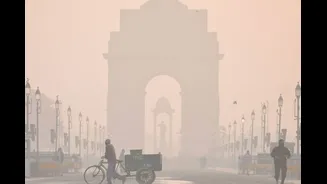

Even as residents of the national capital struggle with deteriorating air quality year after year, the Delhi government failed to utilise the funds meant to solve the crisis. According to a recent report,
Delhi has spent only Rs 14 crore out of the total Rs 81 crore released to the city since 2020-21 under Centre’s National Clean Air Programme (NCAP).
The report released by New Delhi-based Foundation for Responsive Governance shows that between FY 20-21 and FY 25-26, Rs 113 crore (i.e. 54 per cent of its entitlement) was allocated to Delhi under NCAP for air pollution mitigation. Nearly 72 per cent of this – Rs 81 crore had been released till 23 December 2025. However, only Rs 14 crore has been utilised.
Of the Rs 81 crore released to Delhi, Rs 63 crore was transferred to Municipal Corporation of Delhi (MCD), and Rs 9 crore to the and New Delhi Municipal Council (NDMC). There is no clarity on the remaining Rs 9 crore which appears to still be with the Delhi Pollution Control Committee (DPCC), it stated.
WHERE WAS THE MONEY SPENT?
What is starker is that the entire amount has been spent by the Municipal Corporation of Delhi (MCD) and New Delhi Municipal Council (NDMC) on mitigating road dust, and construction and demolition waste, with expenditure on other pollution sources being nil. This has also been raised by experts several times, as Delhi’s primary sources of pollution also include vehicles, industries, and municipal waste burning.
In FY 22-23, the funds were used to purchase 21 truck-mounted multipurpose water sprinklers with anti-smog guns for cleaning street surfaces, and suppressing dust, with 7 additional truck-mounted water sprinklers procured in FY23-24. The remaining amount was spent on the maintenance and operation of these vehicles, with Rs 0.15 crore spent on mitigating C&D waste.
Despite the crores spent on dust mitigation, the levels of PM10 have remained far beyond national and international clean air standards. The data shows that the PM10 levels have increased from 192µg/m3 in FY 19-20 to 213µg/m3 in FY 24-25. Since 2019-20, the year NCAP was implemented, NCAP funds are released by the Environment Ministry to CPCB, and subsequently to urban local bodies through DPCC.
The National Clean Air Programme (NCAP) was launched in January, 2019 to improve air quality in 131 cities (non-attainment cities and million-plus cities) by achieving reductions up to 40 per cent or meeting National Ambient Air Quality Standards for PM10 concentrations by 2025-26. Additionally, performance-linked grants serve as supplementary funding to bridge critical resource gaps. The report further highlights that between FY2020-21 and FY 2025-26, Delhi was approved Rs 113 crore under NCAP, but based on its share, the city should have received Rs 209 crore during this period. However, the approved allocations amounted to only 54 per cent, suggesting that Delhi consistently failed to meet the performance criteria.
For FY 2025-26, no funds have been released December, indicating a delay in disbursement, with releases likely to occur at the end of the financial year.
WHERE IS THE LATEST EMISSION INVENTORY?
Under NCAP, cities are also required to conduct source apportionment studies to determine major sources of emissions, and guide resource allocation. For Delhi, it was conducted by the Automotive Research Association of India (ARAI), and The Energy and Resources Institute (TERI) in August 2018. It showed that transport, biomass burning and industries were major contributors to pollution in winter.
In September, 2023, IIT Kanpur, IIT Delhi, TERI and Airshed also conducted a real-time source apportionment study, which showed that secondary inorganic aerosols followed by biomass burning and vehicular emissions were the largest sources of PM2.5. But this study was never formally approved by the Delhi government, which continued to rely on the dated 2018 study, which is based on data from April 2016 to February 2017.
However, the report noted that during this period, Delhi took other policy interventions including the banning the use of pet coke, and furnace oil, prohibiting 10-year old diesel and 15-year old vehicles, and imposing environmental protection charges on diesel vehicles with an engine capacity of 2000 cc and above.