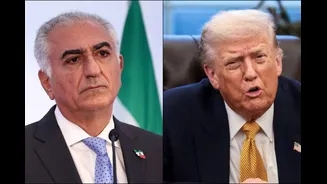

US President Donald Trump on Wednesday said that Iran’s clerical regime could collapse, and expressed uncertainty over exiled Crown Prince Reza Pahlavi’s ability to muster enough support to take over the
reins of the country.
In an exclusive interview with Reuters
in the Oval Office, Trump said it is possible the government in Tehran could fall due to the protests, but that in truth “any regime can fail.”“Whether or not it falls or not, it’s going to be an interesting period of time,” he said. These remarks came after he had repeatedly threatened to intervene in support of protesters in Iran, where thousands of people have been reported killed in a crackdown on the unrest against clerical rule.
Amid heightened tensions over possible US action in Iran, Trump said he had been told “on good authority” that Tehran has stopped its plans for fast trials and executions as widespread protests have left over 3,400 dead. Trump’s threats to Iran had been met with fierce resistance, with Tehran warning of strikes on US military installations in the region and on Israel.
READ MORE: Trump Says Iran Halting Executions; Tehran Claims ‘Full Control’ As 3,400 Killed | Top Points
Trump Reluctant To Back Pahlavi
However, Trump appeared reluctant to lend his full support to Pahlavi, the son of the late shah of Iran, who was ousted from power during the 1979 Islamic Revolution. “He seems very nice, but I don’t know how he’d play within his own country. And we really aren’t up to that point yet,” he told Reuters.
“I don’t know whether or not his country would accept his leadership, and certainly if they would, that would be fine with me,” he further said. Pahlavi, 65, has lived outside Iran since before his father was ousted and has become a prominent voice in the ongoing protests.
These remarks came as US Senator and Trump aide Lindsey Graham met Pahlavi on Wednesday and reiterated Washington’s support for the Iranian people against the “brutal regime” in Tehran.
Pahlavi has repeatedly urged citizens to sustain the movement against the Khamenei regime and warned that those responsible for violence would eventually be held accountable. He has also held talks with White House envoy Steve Witkoff and backed Trump’s rhetoric against the Ayatollah Ali Khamenei-led establishment in Iran.
Pahlavi also said he was ready to return to Iran at a moment’s notice and shared his vision of a “free Iran”, which would end its nuclear military programme and immediately stop support for terrorist groups. He said Iran’s relations with the United States would be normalised and friendship with the American people restored.
Many Iranians, however, view monarchy as another form of authoritarian rule rather than a democratic alternative. Moreover, there is no clear constitutional framework or power structure exists for reinstating a monarchy. Pahlavi has limited political influence inside Iran due to exile and the strength of existing institutions.
Who Is Reza Pahlavi?
Reza Pahlavi is the eldest son of Iran’s last monarch, Mohammad Reza Pahlavi. Born in 1960, he has lived in exile for decades, mainly in the United States, after the monarchy collapsed and the Islamic Republic was established.
From abroad, Pahlavi has positioned himself as a vocal critic of Iran’s clerical leadership. He has repeatedly expressed support for protesters demanding political change, human rights and personal freedoms. During recent unrest, he urged Iranians to continue peaceful resistance and appealed to the international community to support the citizens.
Amid heightened tensions in the Middle East, Pahlavi has continued to call for a change of regime in Tehran. He has advocated a peaceful transition to a secular and democratic system, without directly seeking power himself.