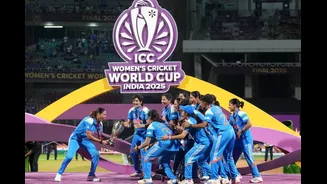

India played their first Women’s ODI World Cup back in 1978, which was the second edition of the tournament. It ended with the Diana Edulji-led side losing all three matches and finishing last among the four
teams. It took 47 long years for the wait to end, but when it finally came, at home, in front of a packed DY Patil Stadium, the wait felt worth it.
The feel of a maiden ICC title got a brilliant build-up throughout the year, before it culminated in a dreamy end on the intervening night of November 2 and 3.
India opened the season with a 3-0 home ODI series sweep over Ireland, under Smriti Mandhana’s captaincy and this tie cemented Pratika Rawal’s place in the side.
Harmanpreet Kaur and her team went on to clinch a tri-nation series in Sri Lanka, which also featured South Africa, in April–May.
On tour in June-July, the Indian women created history by defeating England 3-2 in a five-match series to bag their maiden T20I series victory over the Lionesses. Harmanpreet’s hundred also sealed a 2-1 ODI series win in the UK.
India then faced a stern test at home against the formidable Aussies, losing the ODI series 2-1 after a well-contested battle.
That setback, however, paved the way for the biggest win in the history of Indian women’s cricket.
At the ICC Women’s ODI World Cup 2025, co-hosted by India and Sri Lanka, Harmanpreet and her team defeated the hosts and arch-rivals Pakistan in their opening games, but consecutive defeats to South Africa, Australia and England left them on the verge of elimination.
However, a clutch win against New Zealand in a near must-win clash propelled the side into the semifinals, even as their final group game against Bangladesh was washed out.
India, however, were still to face their sternest challenges.
Facing record seven-time champions Australia, undefeated in their previous 15 Women’s ODI World Cup games, India pulled off a brilliant chase of a tournament-record 338, powered by a sensational hundred from Jemimah Rodrigues.
Star India batter Shafali Verma, drafted in for the injured Pratika Rawal during the knockouts, rose to the occasion in the final against South Africa, scoring a crucial 87 to steer India to a match-winning total.
Despite a hundred from Laura Wolvaardt, South Africa fell 52 runs short as Deepti Sharma, Player of the Series and the tournament’s leading wicket-taker with 22 scalps, claimed a five-for.
Although the experienced Deepti played a brilliant role in India winning the title, the World Cup introduced India to several new names to look up to, bringing in a new generation of trailblazers who would aim to give women’s cricket its biggest-ever platform in the country.
Smriti Mandhana Shines
Ace batter Smriti Mandhana finished as India’s leading run-scorer at the tournament with 434 runs, capping what has been an outstanding year for her with the bat.
Across 23 ODIs, Mandhana amassed 1,362 runs at a brilliant average of 61.9 and a strike rate of 109.92, hitting five hundreds and as many half-centuries to finish 2025 as the leading run-scorer in women’s ODIs.
Mandhana’s runs and centuries in 2025 set a new single-year record in WODIs and she also became only the second Indian, after Mithali Raj, to go past 5,000 runs in the format.
Although Mandhana’s T20I tally of 341 runs in nine games in 2025 was below her usual standards, she became only the second player ever, after New Zealand’s Suzie Bates, to go past 4,000 runs in the format.
Mandhana also entered the 10000-run club in international cricket with her 80-run knock against Sri Lanka in the fourth T20I of the five-match series.
Thus, under coach Amol Muzumdar, 2025 signalled a coming-of-age for the Indian women’s cricket team, evolving from a team known for occasional brilliance into a resilient unit capable of performing under pressure.