






Imagine starting your day and finding that maps will not load, UPI payments fail, flights are delayed across airports, and mobile networks become patchy. Weather forecasts stop updating, and TV broadcasts
flicker out. It sounds like a temporary tech outage, but this is what a disruption in satellite systems could look like.
As warnings emerge from the US about Russia exploring advanced anti-satellite capabilities, and with China rapidly expanding its space warfare technologies, the idea of conflict in orbit is no longer distant. It is becoming a real strategic concern with everyday consequences.
What Are ‘Space Weapons’?
Space weapons are not a single system but a range of technologies designed to disable or destroy satellites. Some are physical, like missiles launched from Earth that can directly hit satellites in orbit. Others are less visible but equally disruptive.
They are essentially divided into three categories: Earth-to-space, space-to-space, and space-to-Earth. At present, Earth-to-space weapons pose the greatest danger and include anti-satellite weapons, which the US, Russia and China have all tested, according to the Center for Arms Control and Non-Proliferation.
Jamming systems can interfere with satellite signals, making navigation or communication unreliable. Cyberattacks can target ground control systems, taking over or shutting down satellites without physically touching them. There are also concerns about high-altitude or nuclear-based systems that could disable multiple satellites at once by generating electromagnetic effects.
While these technologies differ in method, they share a common goal to disrupt the space-based infrastructure that modern societies rely on.
“Space militarisation became an essential aspect of modern wars when ballistic missiles were converted into launch vehicles, and satellites began replacing U-2 spy planes. Today, any precision strike requires navigation satellites, any pre-attack planning and post-attack evaluation require geospatial satellites, and any drone entering enemy airspace requires communication satellites. Space is the undisputable fundamental to mainstream war,” said Chaitanya Giri, Fellow, Space and National Security, Observer Research Foundation (ORF).
Why Are Countries Preparing For Conflict In Space?
Satellites are central to how modern militaries operate. They provide real-time communication, navigation, surveillance and targeting capabilities. Without them, coordination becomes slower and less precise.
This is why countries increasingly see space as a strategic domain, much like land, sea and air. Controlling or denying access to satellites can offer a major advantage in any conflict.
The growing competition between major powers is driving rapid investments in space defence systems. What was once seen as a support layer for military operations is now becoming a frontline domain in its own right.
“The Earth orbits, and near-Earth space may also be an enormous expanse, but it is still a finite dimension. There is a belief among superpowers that whoever controls near-Earth space and Earth orbits will control the Earth. 21st-century great-power games are about control over trade, connectivity, supply chains, and vital terrestrial assets and routes. Great powers realise that all of these could be controlled from space and are hence vying for control of orbits,” explained Giri.
Space Defence Programmes Of Super Powers
The United States Space Force, established in 2019, is the newest branch of the US military and plays a central role in managing the country’s space capabilities. With a budget of around $30 billion, it oversees satellite operations, missile defence systems and space-based communications. The US continues to maintain the world’s largest military satellite fleet, which supports navigation, surveillance, secure communication and early missile detection.
China has rapidly scaled up its space programme under the People’s Liberation Army Strategic Support Force, which handles cyber, electronic and space warfare. The country now operates more than 260 military satellites, strengthening its capabilities in surveillance, navigation and communication. Its BeiDou system serves as an alternative to GPS, reducing dependence on foreign infrastructure while enabling precision targeting and secure military coordination.
Russia’s military space programme remains focused on reconnaissance and secure communications. With over 160 military satellites, it continues to monitor global activity and support defence operations. In recent years, amid rising geopolitical tensions, Russia has also stepped up investments in counter-space technologies, including systems designed to disrupt or jam rival satellites.
In Europe, the European Space Agency is increasingly directing resources towards defence-related space projects. A significant share of its funding is going into satellite-based security systems, cybersecurity and missile detection, as European nations work to strengthen their strategic autonomy in space.
India is also emerging as a key player in military space capabilities. Through its Defence Space Agency, the country has launched multiple satellites for defence purposes since 2019, focusing on surveillance, communication and early warning systems for missile threats.
Meanwhile, France and the UK are stepping up their investments in space defence. French Space Command is focusing on enhancing satellite protection and tracking space threats, while the UK Space Command is working with allies to strengthen satellite surveillance and intelligence-sharing networks.
“An attack may be conducted through any means, whether kinetic or non-kinetic. Currently, non-kinetic methods are preferred due to their cost-effectiveness and low attribution. The adversary often aims to remain concealed and discreet. An assault on a satellite necessitates either its replacement or acceptance of ongoing incapacity in its absence. Moreover, a greater threat arises when a nation or a space operations centre believes its satellite functions properly, while in reality it has long been compromised and has been covertly supplying poisoned or corrupted data without detection,” pointed out Giri.
What Happens If Satellites Are Attacked?
The destruction of all artificial satellites would trigger an immediate and far-reaching breakdown of modern life. As of early 2026, more than 15,000 satellites orbit Earth, supporting everything from navigation and banking to communication and weather forecasting. Losing them would push global systems back decades, forcing a sudden return to manual and analogue operations.
“Satellite-based services have become an essential backbone of governance, planning, forecasting, national security, and certain strategic utilities in the public interest. The public may not be the direct consumer of space services, barring a few services like broadcasting and stock market trading, but through the government, the public becomes the direct customer of these services. In such a situation, India must rely on sovereign technologies and not allow dependencies or interference to creep in. A lackadaisical approach to sovereignty will cause disruptions, and dependencies will lead to technological colonisation,” said Giri.
Navigation would be among the first to collapse. GPS-based services, from maps and logistics to ride-hailing and deliveries, would stop functioning, disrupting transport and supply chains. Communication networks would also take a major hit. Satellite internet services would vanish, and while fibre networks could absorb some traffic, rural and remote regions would lose connectivity almost entirely. Even urban networks could slow down or fail due to overload.
The financial system would face severe disruption. Many banking operations, ATMs and digital payments depend on precise satellite timing. Without it, transactions could fail and markets could halt, forcing a shift to cash-based transactions in the short term. Satellite television would go offline instantly.
Air travel would become far more complex, especially over oceans where satellite navigation is critical. Flights would have to rely on older, less precise systems, increasing delays and reducing efficiency. At sea, ships would fall back on traditional navigation methods, raising risks in poor visibility.
Power grids, which depend on satellite timing to balance loads, could experience instability and blackouts. Weather forecasting would also suffer, with accuracy dropping sharply beyond short-term predictions and weakening early warning systems for extreme events.
Military systems would lose critical visibility, including missile tracking and surveillance. Agriculture, too, would be affected, as modern farming relies on satellite data for precision operations.
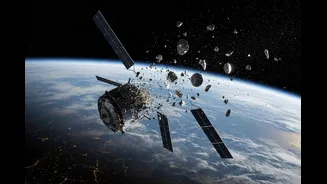
If satellites were destroyed in a single event, the risk of the Kessler Syndrome would become immediate. A single collision could trigger a chain reaction, creating vast clouds of high-speed debris. Travelling at over 18,000 mph, this debris could make entire orbits unusable for decades, preventing new satellites from being launched and locking the world into a prolonged technological setback.
What Space Militarisation Means For India’s Economy & Geopolitics
India is increasingly dependent on satellite systems from navigation services, telecom networks, television broadcasting to weather monitoring. Digital payments, including widely used systems like UPI, depend on precise timing and communication networks linked to satellites. Any disruption could have cascading effects across banking and commerce.
India is also located in a region where space capabilities are evolving rapidly. China’s advances in anti-satellite technologies and broader military modernisation add a strategic dimension to the issue.
At the same time, India has demonstrated its own capabilities. In 2019, the country conducted an anti-satellite test called ‘Mission Shakti’, signalling its entry into this domain. However, questions remain about preparedness, resilience and the ability to protect critical infrastructure in the event of a broader disruption.
“We are getting there. However, let us acknowledge that India has been a diligent follower of many international rules that the rule-making superpowers have flouted in upholding their interests. An economically stronger India, a more autonomous India — one with the ability to ward off the taming influence of great powers, would invest more in space militarisation to secure its economy and geopolitical interests. We know what the superpowers are aiming for; we do know we never operated under the same space-dominance-driven mindset, but today we do realise there is no time to remain meek. We will do whatever it takes to secure our interests,” said Giri.
What Are The Global Rules Around Space Warfare?
The Outer Space Treaty prohibits placing nuclear weapons in space, but it does not comprehensively address modern anti-satellite technologies or emerging threats.
There are few enforceable norms governing how countries develop or deploy space weapons. This creates a grey area where technological capabilities are advancing faster than international agreements.
As more nations enter the space domain, the absence of clear rules increases the risk of escalation or unintended consequences.
“Because the current global rules were made by those who themselves flouted them. Space is a realm of a few powers and their junior partners. Since orbital, near-Earth military dominance is the end-goal, no one would want to prevent its weaponization,” said Giri.