







From how to upload a Panchayat asset photo and its details to clarifying scheme guidelines, eGramSaathi, an AI-powered assistant developed by the Ministry of Panchayati Raj, is now positioning itself as the digital
bridge between village citizens and grassroots governance.
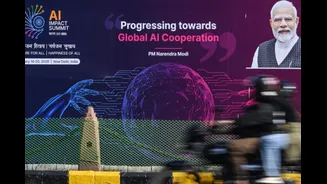
And this is not a pilot project tucked away in files. It will be live on the international stage at the India AI Impact Expo 2026 in New Delhi, starting February 16. News18 reviewed the documents prepared for the summit.
At a time when Artificial Intelligence (AI) is often showcased through flashy consumer apps and global tech debates, the Ministry of Panchayati Raj is quietly placing AI inside the Gram Sabha, empowering India’s grassroots governance.
The Ministry will present a suite of AI-enabled governance tools designed specifically for decentralised administration. Alongside eGramSaathi, there is SabhaSaar, an AI system that records, transcribes and converts Gram Sabha deliberations into structured, actionable minutes of meeting, reducing paperwork and ensuring decisions don’t dissolve into memory.
Then comes PRAMAN (Panchayati Raj Asset Monitoring and Notification), an image analytics platform that automatically validates uploaded asset photographs, checks authenticity, flags duplication and assesses quality. In a system where physical asset verification often slows schemes, automation could prove transformative.
But the showcase is not confined to dashboards and screens. Visitors will be able to — Be the Sarpanch — a role-based simulation placing participants inside AI-assisted decision-making scenarios. A virtual reality Gram Sabha experience, immersive walkthroughs and live demonstrations aim to show how technology can simplify complex administrative processes without displacing human agency.
The larger message is unmistakable here. AI in India’s public systems is not being framed merely as efficiency software, but as an accountability tool. By embedding transcription accuracy, image verification and instant citizen responses into Panchayat workflows, the Ministry is signalling that emerging technologies can strengthen transparency at the grassroots, where governance is most immediate.
As India hosts what is being described as a first-of-its-kind global AI summit in the Global South, the rural Ministry’s bet is clear. The future of AI will not be defined only in boardrooms, but in village meetings, asset registers and citizen queries, answered, perhaps, by a chatbot.