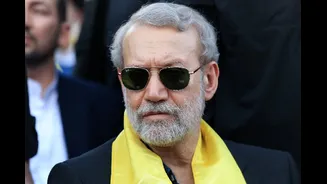

The United States on Thursday imposed fresh sanctions on senior Iranian security officials over what it described as a violent crackdown on protests, naming Ali Larijani, secretary of Iran’s Supreme Council
for National Security, as a central figure behind the use of force against demonstrators.
Announcing the move, US Treasury Secretary Scott Bessent said the sanctions were directed at Iranian leaders responsible for directing violence against peaceful protesters. He said the action was taken at the direction of US President Donald Trump and signalled Washington’s support for what he described as the Iranian people’s demand for freedom and justice.
According to the US Department of the Treasury’s Office of Foreign Assets Control (OFAC), Larijani was among the first senior Iranian officials to publicly call for force in response to protests that erupted across the country in December. US authorities said he coordinated the state’s security response to the demonstrations on behalf of Iran’s supreme leadership.
The sanctions also target senior commanders from Iran’s security and paramilitary structures, including officials linked to the Islamic Revolutionary Guard Corps and internal law enforcement units. US officials accused these forces of firing live ammunition at protesters and carrying out violent operations during the unrest.
Those named include Mohammad Reza Hashemifar, a senior law enforcement commander in Lorestan province, and Nematollah Bagheri, the IRGC commander for the province. The US Treasury said security forces under their command were involved in killings and intimidation during protests in the region.
Also sanctioned were Azizollah Maleki and Yadollah Buali, senior security officials in Fars province, where authorities are accused of overseeing violent crackdowns on demonstrators and coercing families of victims during the unrest.
Alongside the security officials, OFAC said it had also sanctioned individuals and entities linked to what it described as Iran’s shadow banking networks. These networks, the Treasury said, were used to launder revenue from petroleum and petrochemical sales through sanctioned financial institutions, including Bank Melli and Shahr Bank. US officials said the funds were used to finance internal repression and activities abroad, rather than to address Iran’s economic crisis, marked by high inflation and worsening living conditions.