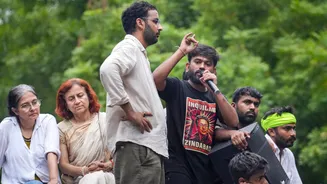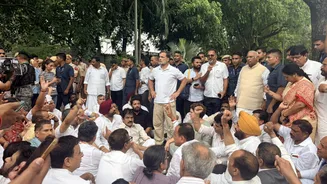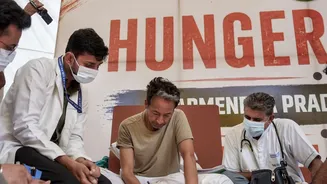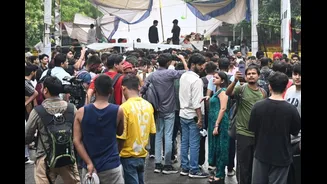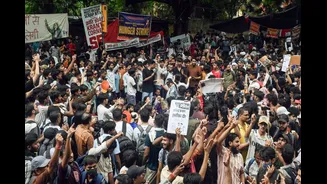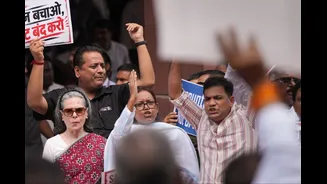

Congress Parliamentary Party chairperson Sonia Gandhi has launched a scathing attack on the Narendra Modi-led government over the ongoing student protests, alleging that the Centre has responded to young
people’s demands for accountability and educational reforms with “cowardice and wanton cruelty” instead of dialogue.
In an opinion article titled ‘An education system’s collapse, young India’s trauma’, published in The Hindu, Gandhi argued that India’s education landscape has deteriorated under the Modi government and said the recent wave of student protests reflects widespread frustration over paper leaks, the state of public education and the lack of accountability.
“Their demands have been straightforward and to the point: accountability from the Government of India and education reform. The Narendra Modi government has responded to their courage with cowardice and wanton cruelty, treating them not as inheritors of the future but as enemies of the nation,” Gandhi wrote.
She said it was the government’s moral, political and constitutional responsibility to stand with students and safeguard their future, rather than suppressing their voices.
According to Gandhi, the protests are “a natural consequence” of a bleak education system combined with what she described as the government’s unwillingness to be accountable.
Criticism Over Police Action
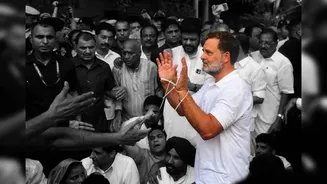
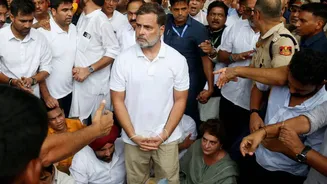
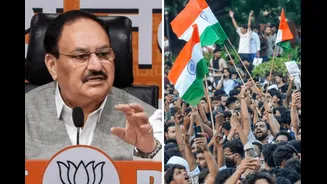
Referring to the protests held on July 20, 2026, Gandhi described the day as “a day of infamy” and alleged that the Delhi Police and Central Armed Police Forces (CAPFs) used excessive force against peaceful demonstrators.
According to her article, numerous protesters were injured after police resorted to lathicharge, tear gas and pellet firing. She claimed that even students returning home were not spared.
“The videos from that day are seared into our memories and have stirred our collective conscience. Only the government and its captive media are spinning stories around this spontaneous rising tide of protest,” Gandhi wrote, adding, “Stop, these are our sons and daughters, our young men and women.”
She also alleged that the use of force against student protesters followed a familiar pattern, drawing comparisons with the police action during the Citizenship (Amendment) Act-National Register of Citizens (CAA-NRC) protests in 2020 and the protests by India’s women wrestlers.
According to Gandhi, the Modi government has repeatedly preferred coercion over dialogue.
“Instead of reaching out with understanding to our future doctors and engineers, teachers and civil servants, entrepreneurs and nation builders, it unleashed the repressive power of the state on them. This can neither be forgiven nor forgotten,” she wrote.
Raises Questions Over Education Policies
In the article, Gandhi argued that the current unrest stems from deeper structural issues in India’s education system.
She claimed that the Centre has steadily reduced its emphasis on public education, alleging that the share of the Union Budget allocated to school education has fallen by 50 per cent, while the allocation for higher education has declined by 33 per cent.
Gandhi further alleged that nearly one lakh government schools have been shut over the past 12 years even as around 43,000 private schools have opened, adding that many of these institutions are run by organisations linked to the Rashtriya Swayamsevak Sangh (RSS).
She also claimed that families are increasingly forced to spend large amounts on private coaching, stating that expenditure on NEET coaching alone is comparable to the government’s overall spending on public education.
NTA, Paper Leaks And Accountability
Gandhi also criticised the National Testing Agency (NTA), alleging that the centralisation of entrance examinations through tests such as the Common University Entrance Test (CUET) has weakened India’s examination system.
She wrote in The Hindu that the NTA is an understaffed body that relies heavily on private contractors to conduct examinations and claimed that the country has witnessed 152 examination paper leaks over the past 12 years, including nine involving the NTA since its establishment in 2017.
According to Gandhi, the privatisation, commercialisation and centralisation of examinations have collectively eroded confidence in India’s education system.
She further argued that the challenges faced by students do not end with examinations, saying employment opportunities after graduation have become increasingly limited.
The Congress leader also criticised Union Education Minister Dharmendra Pradhan, alleging that he had dismissed recommendations made by the Parliamentary Standing Committee on Education to strengthen the NTA because Opposition members were part of the panel.
She said his refusal to accept responsibility or resign despite repeated controversies surrounding public examinations has further fuelled public anger.
Concluding her article, Gandhi alleged that the Modi government has continued to portray dissent as anti-national rather than engaging with students’ concerns.
She said the government should introspect on the policies that have led to the current protests instead of resorting to force, asserting that India’s students have exposed what she called the government’s failures and are demanding accountability and meaningful reform.