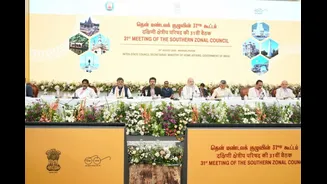




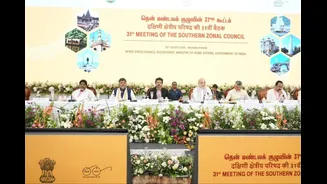
Telangana Chief Minister Revanth Reddy skipped the 31st meeting of the Southern Zonal Council chaired by Union Home Minister Amit Shah, held in Mahabalipuram, Tamil Nadu, on August 20, 2026, due to an overseas
tour to the United Kingdom and the United States.
Telangana was instead represented at the summit by Deputy Chief Minister Bhatti Vikramarka Mallu.
The Southern Zonal Council comprises Andhra Pradesh, Karnataka, Kerala, Tamil Nadu, Telangana, Puducherry, Andaman and Nicobar Islands and Lakshadweep. Tamil Nadu Chief Minister C. Joseph Vijay is the vice-chairman of the council.
The 31st meeting of the Southern Zonal Council was held at the Taj Fisherman’s Cove hotel in Kovalam and hosted by the Tamil Nadu government. According to the Ministry of Home Affairs, chief ministers and senior representatives of member states and Union Territories participated in the meeting.
What Is Southern Zonal Council?
The Southern Zonal Council is one of five Zonal Councils created under Sections 15 to 22 of the States Reorganisation Act, 1956.
The vice-chairmanship is held by the chief ministers of the member states on a rotational basis, according to the Ministry of Home Affairs.
The 31st meeting was convened by the Inter-State Council Secretariat under the Ministry of Home Affairs, with the Tamil Nadu government hosting the event.
Alongside the chief ministers, Lieutenant Governors and administrators of the participating states and Union Territories attended the meeting. Two senior ministers from each state were also part of the gathering, along with chief secretaries, advisers, other senior state officials and senior Central government officers.
DK Shivakumar Seeks To Retain 543 Lok Sabha Seats
Karnataka Chief Minister DK Shivakumar has urged the Southern Zonal Council to pass a resolution asking the Union government to retain the 1971 census as the basis for delimitation and keep the Lok Sabha’s existing strength of 543 seats unchanged for the next 25 years.
He also called for women’s reservation to be accommodated within the existing 543 seats.
Speaking at the 31st meeting of the Southern Zonal Council, Shivakumar argued that the southern states should not face a reduction in their political representation because of their success in controlling population growth.
“We welcome the assurance that no southern state will lose seats. But representation is not only about numbers. It is about weight, and about voice,” he said.
According to Shivakumar, the southern states had successfully responded to the country’s call for population stabilisation and should not be penalised for their efforts during the delimitation exercise.
“That success must never become the reason to make our voice smaller. Our economic weight must be matched with political voice,” he said.
The Karnataka Chief Minister called for the 1971 population basis to be retained and the total number of Lok Sabha seats to remain unchanged.
“I am confident that all the Chief Ministers here will support me in what I say. Let the 1971 basis be honoured, and let the strength of our voice be protected,” he said.
Shivakumar Links Delimitation With Women’s Reservation
Shivakumar also raised the issue of women’s reservation, saying its implementation should not be held up because of a fresh delimitation exercise.
“Women have waited long enough for their rightful representation. Their reservation should not have to wait for a population count,” he said.
He called on the Southern Zonal Council to adopt a resolution seeking to freeze the number of Lok Sabha seats at 543 for the next 25 years while providing women’s reservation within the existing strength.
“I therefore urge this Council to move a resolution to freeze the number of seats in Lok Sabha to the current number and provide women’s reservation within that number. I call upon my fellow Chief Ministers to stand together behind our shared stand,” he said.
Shivakumar’s remarks come amid concerns in southern states that a population-based delimitation could change the balance of parliamentary representation between states that have successfully implemented population-control measures and those with larger populations.
He said protecting the political voice of the southern states was essential to maintaining fairness in India’s federal structure.
“Fairness in our voice is one half of the story. Fairness in our resources is the other,” Shivakumar said.
Shivakumar Pushes For Water Cooperation
Inter-state water disputes also featured in DK Shivakumar’s address, with the Karnataka CM calling for a shift from “water sharing to water cooperation”.
Describing the Cauvery, Krishna, Tungabhadra, Pennar and Palar rivers as lifelines of the southern peninsula, he said dialogue could help resolve water-related disputes between states.
Referring to a June 25 meeting involving Karnataka, Andhra Pradesh and Telangana, Shivakumar stressed that Karnataka’s lawful share under tribunal awards and timely completion of projects benefiting its farmers must be protected.
He also said Karnataka’s position on the Krishna, Upper Bhadra, river interlinking projects and the Mekedatu project would be placed before the Council, while arguing that Mekedatu could benefit farmers in Tamil Nadu and Puducherry.
Amit Shah Raises Vande Mataram Issue
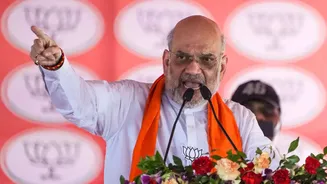
Union Home Minister Amit Shah raised the issue of Vande Mataram during the meeting, accusing the Congress of splitting the song in 1937 as part of what he called “Muslim appeasement”.
He also criticised a Congress decision regarding the singing of Vande Mataram at government functions, calling it “anti-national” and alleging a “partition mindset”. The BJP, he said, condemned the decision.
The Zonal Councils serve as advisory platforms for discussing and resolving issues involving multiple states or the Centre and states.