



Scientists believe there’s an enormous amount of water hidden deep beneath the Earth’s surface – possibly more than all the oceans we see combined.
This isn’t an ocean you can sail across.
It lies hundreds
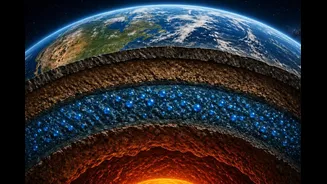
of kilometres underground, trapped inside a mineral called ringwoodite, found in the Earth’s mantle. This layer sits far below the crust, in a zone known as the “transition zone” roughly 400 to 700 kilometres beneath our feet.
What makes this discovery interesting is the way the water actually exists.
It’s not sitting there like an underground ocean. There are no waves, no pools. Instead, the water is locked inside rock, held within a mineral at a microscopic level. It’s closer to a sponge than a sea, with the water trapped inside the material itself.
Scientists first picked up hints of this while studying earthquake waves. As these waves travelled through the Earth, they slowed down in certain zones, which suggested something unusual was there. Later, tiny samples of a mineral called ringwoodite, brought closer to the surface, helped confirm it.
And here is where things get really interesting.
Should the deep mantle have large amounts of such rocks rich in water, then the amount of water stored within may actually exceed the total volume of water in all the world’s oceans put together.
However, there’s no secret underground sea hidden below our feet.
This water does not represent any reservoirs that can be accessed by us, nor does it behave like the familiar water we drink every day. It is an integral part of the Earth’s inner workings, silently shaping how heat flows, rocks move, and plates interact.
It also changes how we think about where Earth’s water actually is.
Instead of being limited to oceans, rivers and clouds, some of it may be cycling much deeper inside the planet than we ever imagined.
Instead of being limited to oceans, rivers and the atmosphere, water may be moving much deeper through the planet, cycling in ways that take millions of years.
That’s what makes this idea so striking. We tend to think we understand where Earth’s water is. But this suggests that a large part of it may be hidden far below, in a form we rarely think about.
Not visible, not reachable – but still very much there.