
Barely days after US forces captured Venezuelan President Nicolás Maduro in a military raid on Caracas, Washington has extended its pressure campaign to the high seas. On Wednesday, the US seized two Venezuela-linked
oil tankers in the Atlantic Ocean, one of which — the Marinera — was sailing under the Russian flag, and the Panama-flagged M Sophia carrying Venezuelan crude.
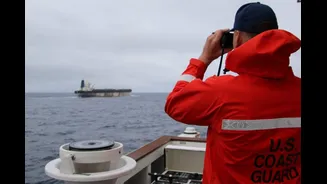
The Marinera had been pursued for weeks. US officials said that the vessel refused boarding last month before changing its name from Bella 1, altering its flag, and heading towards northern waters. A judicial warrant authorised the seizure after US Coast Guard and special operations teams tracked the ship across the Atlantic.
US Attorney General Pam Bondi said in a statement that the Marinera crew had made “frantic efforts to avoid apprehension” and “failed to obey” Coast Guard orders, and so faces criminal charges.
The second vessel, the M Sophia, was intercepted near the northeast coast of South America. Records from Venezuela’s state oil company PDVSA indicated it was fully loaded with crude. Together, the seizures mark the continuation of Washington’s effort to restrict sanctioned shipments after Maduro’s removal.
US Vice President JD Vance said the Marinera had attempted to “pretend to be a Russian oil tanker in an effort to avoid the sanctions regime”. Washington maintains that both vessels belong to a sanctions-evading shadow fleet used by Venezuela, Iran and Russia. The Marinera was empty of oil at the time of capture but has been sanctioned since 2024 for transporting cargo linked to a Hezbollah-owned company.
China criticised the US action, describing it as “typical bullying” and accusing Washington of trying to dictate how Venezuela disposes of its resources. “The United States’ brazen use of force against Venezuela and its demand for ‘America First’ when Venezuela disposes of its own oil resources are typical acts of bullying,” Chinese Foreign Ministry spokesperson Mao Ning told reporters.
The operation has unfolded as Trump’s administration seeks to negotiate oil deals with Venezuela, with the White House planning a selective rollback of earlier sanctions in order to refine and sell crude that has remained stuck in the country since 2019.
Inside The Marinera’s Shifting Identity And Long Pursuit
The Marinera’s complex history has drawn scrutiny. The vessel was formerly known as the Bella 1 and had been sanctioned in July 2024 for transporting illicit cargo on behalf of an Iranian-linked network. The tanker had changed its name five times in the past five years and had previously flown the flag of Guyana when entering the Caribbean.
According to statements made by UK Defence Secretary John Healey, the Bella 1 had been stateless when using the Guyana flag improperly, and a stateless vessel may be intercepted under the law of the interdicting state. Healey argued that the ship’s repeated renaming and flag-switching placed it at the centre of a wider network of sanctions evasion involving Russia and Iran.
The UK says the ship is part of an “increasing web of shadow shipping that fuels and funds instability”, noting that Russia operates a large shadow fleet to support its war effort in Ukraine.
Data collected by TankerTrackers, a specialist monitor, showed Bella 1 had transported 7.3m barrels of Iranian crude oil and 3.7m barrels of Venezuelan crude oil to China between October 2021 and September 2025.
The vessel was empty of oil during the seizure. However, the US maintains that the route it previously took between Iran and Venezuela is associated with illicit trade, including weapons transfers.
How The US And UK Coordinated The High-Seas Operation
The Marinera’s capture was preceded by intensive US and UK activity across the North Atlantic. US European Command tracked the vessel for weeks, deploying warships, fighter jets, surveillance aircraft, AC-130 gunships and special operations helicopters. A large number of C-17 Globemaster transport aircraft landed at RAF bases in the UK in the 48 hours before the operation, reportedly carrying Black Hawk and Chinook helicopters used for special missions.
On Wednesday, troops from the US Army’s Night Stalkers descended onto the deck from hovering helicopters, bringing the chase to an end.
According to The Guardian, Britain provided surveillance, refuelling and logistical support. RAF aircraft monitored the tanker’s movements, while the Royal Navy’s RFA Tideforce provided supplies during the final stage of the mission. UK Defence Secretary Healey told MPs that the UK allowed US aircraft to use its bases to prepare for and carry out the operation, adding that the seizure complied with international law.
The British government said it acted after receiving a request from the United States, though it emphasised that no British personnel boarded the ship. Healey told Parliament that the action was part of a broader effort to step up operations against shadow fleets operating across global shipping routes.
Russia Condemns The Seizure And Warns Of Consequences
Russia’s reaction was immediate and strongly worded. Moscow said that the United States had violated maritime law, arguing that under the 1982 UN Convention on the Law of the Sea, freedom of navigation applies on the high seas and that no state may use force against a vessel properly registered under another country’s jurisdiction.
Russian officials demanded that the US guarantee the safety and “humane and dignified” treatment of its citizens on board and ensure their immediate return.
“Russia demands that the US ensure humane and dignified treatment of Russian citizens on the ship Marinera, and respect their rights and interests,” the Putin government was quoted as telling Tass media.
A Russian lawmaker described the capture as “outright piracy” and suggested that the United States could only be stopped through forceful retaliation, including the sinking of US Coast Guard boats.
According to a Reuters report, a Russian submarine and other vessels were reportedly in the vicinity during the Marinera’s apprehension. The presence of Russian naval assets near a US special forces operation underscored how swiftly a sanctions enforcement mission could have escalated into a military confrontation.
Russia also linked the seizure to wider political dynamics, interpreting the move as part of the evolving US approach toward Moscow during ongoing discussions related to Ukraine.
A New Point Of Friction Between Washington And Moscow?
The capture of the Marinera is expected to further strain relations between Washington and Moscow. The timing is particularly sensitive. The US president is currently trying to secure a peace deal to end the Russia–Ukraine war, and the operation has been read by many as a sign that his approach towards Vladimir Putin has cooled.
Some interpretations suggest that the tanker seizure could be intended to pressure Moscow into compromising on the terms of a Ukraine settlement. Whatever the motive, the effect has been to place a new layer of tension on an already fragile diplomatic landscape.
The episode also follows the US raid in Caracas that resulted in Maduro’s capture, an operation that exposed gaps in the air defence systems Venezuela had long claimed were backed by Russia. The interception of a vessel sailing under the Russian flag, despite its attempts to evade detection and change identity, has been read as another demonstration that Moscow’s maritime networks are not as insulated as they appear.
What happens next remains uncertain. The US has not signalled that further maritime actions are imminent, though senior officials, including Stephen Miller and Pam Bondi, have stated that American law and national security will determine which maritime energy shipments are permitted. Russia has framed the seizure as illegal and provocative, while domestic debate in the UK has questioned the legal foundation for the operation.
Whether it develops into a broader confrontation will depend on how each side interprets the limits of enforcement, navigation and geopolitical signalling in the weeks ahead.