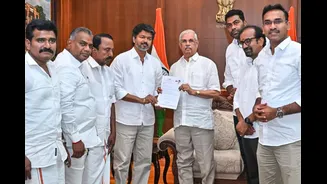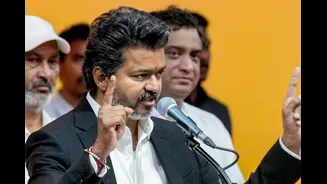








Tamil Nadu debt: In his first speech after being sworn in as Tamil Nadu Chief Minister, TVK chief C Joseph Vijay on Sunday launched a scathing attack on his predecessor MK Stalin and the DMK-led government,
claiming that the latter had left behind a massive debt burden of Rs 10 lakh crore and emptied the state treasury.
While addressing the gathering after taking the oath, the Chief Minister said that the financial condition of the state was far worse than expected and hinted at releasing a White Paper on Tamil Nadu’s finances for greater transparency.
“The condition in which our Tamil Nadu government has been left is something I have seen for myself,” Vijay said, adding, “The last government has gone out after borrowing debts of more than Rs 10 lakh crore; the treasury has been completely emptied before they left office.”
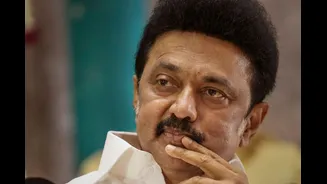
The remarks triggered a sharp response from former Chief Minister M K Stalin, who rejected the allegation that the state coffers were empty.
“Don’t start saying right away that the government has no money. It does have it. What’s needed is the will to give it to the people, and the ability to govern,” Stalin said in a post on X.
The exchange mirrors a similar situation from 2021, when then Finance Minister P Thiaga Rajan released a White Paper soon after the DMK came to power, describing Tamil Nadu’s finances as “dire” after a decade of AIADMK rule. Now, five years later, Vijay is preparing a similar exercise, this time blaming the outgoing DMK administration for leaving the state “in bad shape”.
What Numbers Say About Tamil Nadu Debt?
According to the data released by the Reserve Bank of India (RBI), Tamil Nadu’s outstanding liabilities stood at Rs 9.56 lakh crore at the end of FY25 – the highest among Indian states. At the same time, Tamil Nadu is the fastest-growing state in the country, posting a real growth rate of 10.8% in FY26 on top of 11.2% in FY25 as per the old GDP series with 2011-12 as the base year.
Tamil Nadu remains one of India’s fastest-growing states, recording real growth rates above 10% in the last two financial years. Faster-growing economies can generally sustain higher debt because of stronger repayment capacity. The state’s debt-to-GSDP ratio stood at 30.6% in FY25, lower than the pandemic peak of over 32% in FY22, the RBI data stated.
Even the DMK government’s own 2021 White Paper had admitted that Tamil Nadu’s financial condition was weak and that the state had borrowed more money than any other state in India. This means the Rs 10 lakh crore debt mentioned by CM Vijay is not only because of the last DMK government. The debt has been increasing over many years under different governments, the Indian Express reported.
A recent report by the Finance Commission also showed that Tamil Nadu’s debt kept rising steadily over the years and jumped sharply during the Covid-19 period.
A major concern, however, is Tamil Nadu’s high committed expenditure – spending on salaries, pensions, and interest payments. According to PRS Legislative Research, as reported by the Indian Express, nearly 62% of the state’s revenue receipts in FY26 were budgeted to go towards these mandatory expenses, leaving less room for development spending.
In this situation, Vijay’s promise of giving 200 units of free electricity every two months becomes important because it will increase government spending.
In 2025-26, Tamil Nadu had already planned to spend more than Rs 72,000 crore on subsidies and welfare schemes. This was even higher than the amount set aside for development projects like roads and infrastructure. As per estimates, fulfilling all the welfare promises made in Vijay’s election manifesto could significantly increase fiscal pressure. The proposed schemes could push annual welfare spending close to Rs 1 lakh crore.
Tamil Nadu faces long-term fiscal challenges because of its ageing population. The RBI, in its study of states’ 2025-26 budgets, had noted earlier this year in January that by 2026, Kerala and Tamil Nadu are expected to enter a so-called ‘ageing category’ when more than 15% of a state’s population is above the age of 60.
This is likely to increase expenditure on pensions, healthcare, and social welfare in the coming years.