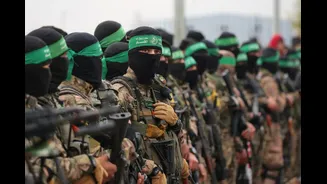

Amid heightened concerns over Hamas’ efforts to rebuild its operational infrastructure in Gaza and leverage international proxies for attacks, Israel has formally urged India to designate Hamas as a terrorist
organisation. Israeli officials say the group’s strengthening ties with Pakistan-based Lashkar-e-Taiba (LeT) and Iran-backed networks pose an increasing security threat to both countries.
Speaking to journalists in Jerusalem, a senior official from Israel’s foreign ministry said, “We request that India must work hard to sanction and designate organisations such as Hamas as terrorist groups. Israel designated Lashkar-e-Taiba a few years ago. We would like to see reciprocation from India.”
Israel designated LeT as a terror group in 2023, a month after the October 7 attacks.
The demand follows similar appeals from the Israeli Defence Forces (IDF). Lieutenant Colonel Nadav Shoshani, the IDF’s International Spokesperson, said India and Israel “have a common enemy” and that a formal ban would send a strong message. “It’s not just about freezing assets or banning operatives. It signals that no Hamas operative should step on Indian soil,” he said.
Hamas–LeT Links Deepening, Says Israel
Israeli officials claim India is aware of the growing interconnectedness of Iranian-backed groups and global terror outfits. They warn that banning Hamas could influence counterterrorism policies across neighbouring countries, including Bangladesh, Maldives, and Nepal.
The foreign ministry official cited increasing operational coordination between Hamas and LeT, along with Iran’s use of international criminal networks to carry out covert attacks.
“We are seeing significant links between Hamas and Lashkar-e-Taiba. Hamas and Hezbollah are using international criminal proxies to operate terror attacks. We won’t see an Iranian operative attack in Europe, but rather an international proxy linked to Iran—as seen in London,” the official said.
Israel has also asked New Delhi to halt its financial support to UNRWA, the UN agency for Palestinian refugees, accusing it of systematic Hamas infiltration. India contributed $5 million to UNRWA in 2024–25. However, officials acknowledged India’s long-standing policy of balancing ties across West Asia.
Iran Doubling Down Despite June War, Say Israeli Officials
Israeli officials warned that Iran has not shifted its regional strategy despite the 12-day conflict with Israel in June and subsequent US strikes on Iranian nuclear facilities.
“We believed Iran’s policy would shift after the war, but Tehran is instead doubling down on proxies such as Hamas and Hezbollah,” the official said.
They also criticised the current US administration’s pressure campaign on Iran as insufficient. “Sanctions and designations are a start, but enforcement must be much stronger,” the official added. While Israel maintains it does not seek regime change in Iran, the official noted that any such change driven by internal economic pressure “would not be a bad thing.”
Sudan Emerging as Iran’s New Strategic Outpost
Israel’s most urgent concern, officials said, is Iran’s growing influence in Africa, particularly in the conflict-hit Horn of Africa.
“One of our biggest concerns now is the spillover of Iranian influence into Sudan,” an official said.
Tehran reportedly views Sudan as a potential node in its expanding ‘Axis of Resistance’ and as a forward base for Hamas activities. Israeli officials say weapons transfers are already taking place through regional militia channels.
Sudan and Iran restored diplomatic ties in 2024 amid Sudan’s ongoing civil war. Since then, Iran’s Revolutionary Guard Corps (IRGC) is believed to have been supplying drones, munitions, and intelligence to the Sudanese Armed Forces. Sudan’s strategic position along the Red Sea, officials warn, makes it a critical foothold for Tehran at a time when Houthi activity has diminished following US and Israeli strikes.