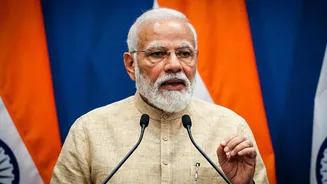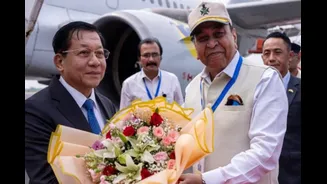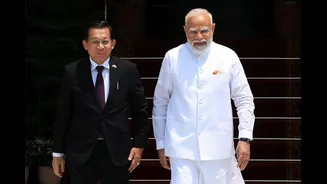




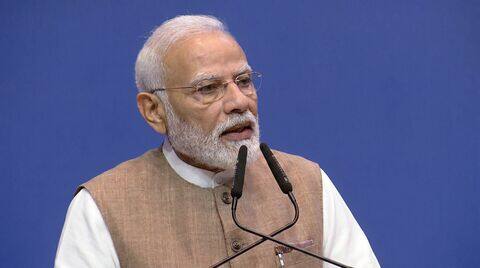
Prime Minister Narendra Modi on Monday met Myanmar junta chief and president Min Aung Hlaing at Hyderabad House during the latter’s five-day visit to India, which is being considered crucial in reshaping
the ties between India and Myanmar against the backdrop of Chinese influence in Southeast Asia.
The two leaders are set to hold talks on several key issues, including security and connectivity, that underscore the gradual return of regional re-engagement with Myanmar five years after the military leadership toppled a democratically elected government.
#WATCH | Delhi | Prime Minister Narendra Modi meets Myanmar President U Min Aung Hlaing at Hyderabad House
(Source: DD) pic.twitter.com/H2uzA7e3Cy
— ANI (@ANI) June 1, 2026
The visit marks Min Aung Hlaing’s first foreign trip since assuming office as Myanmar’s president earlier this year. It also comes as Myanmar seeks to emerge from years of diplomatic isolation while India looks to strengthen its influence and dilute China’s outsized influence on Myanmar, while seeking access to the country’s deposits of critical rare earths.
On Sunday, the Myanmar President held talks with National Security Advisor Ajit Doval, which focused on key security challenges along the India-Myanmar border, including insurgency, illegal immigration and cross-border trafficking.
External Affairs Minister S Jaishankar also called on the Myanmar President on Saturday and appreciated his positive approach towards strengthening bilateral relations between the two countries.
According to top-level sources, the engagement reflects India’s calibrated approach towards neighbourhood stability, with emphasis on stronger intelligence cooperation, defence engagement and economic connectivity.
Why Is Myanmar President’s Visit Important?
Hlaing arrived in Bihar’s Bodh Gaya on Saturday, accompanied by a high-level delegation comprising several Cabinet Ministers, senior officials and business leaders. The visit is aimed at strengthening the multifaceted relations between the two countries.
One of the biggest factors driving the visit is China. India sees Myanmar as a critical neighbour in its efforts to counterbalance China’s growing presence in the region. India is particularly interested in expanding cooperation in trade, infrastructure, connectivity and access to strategic resources.
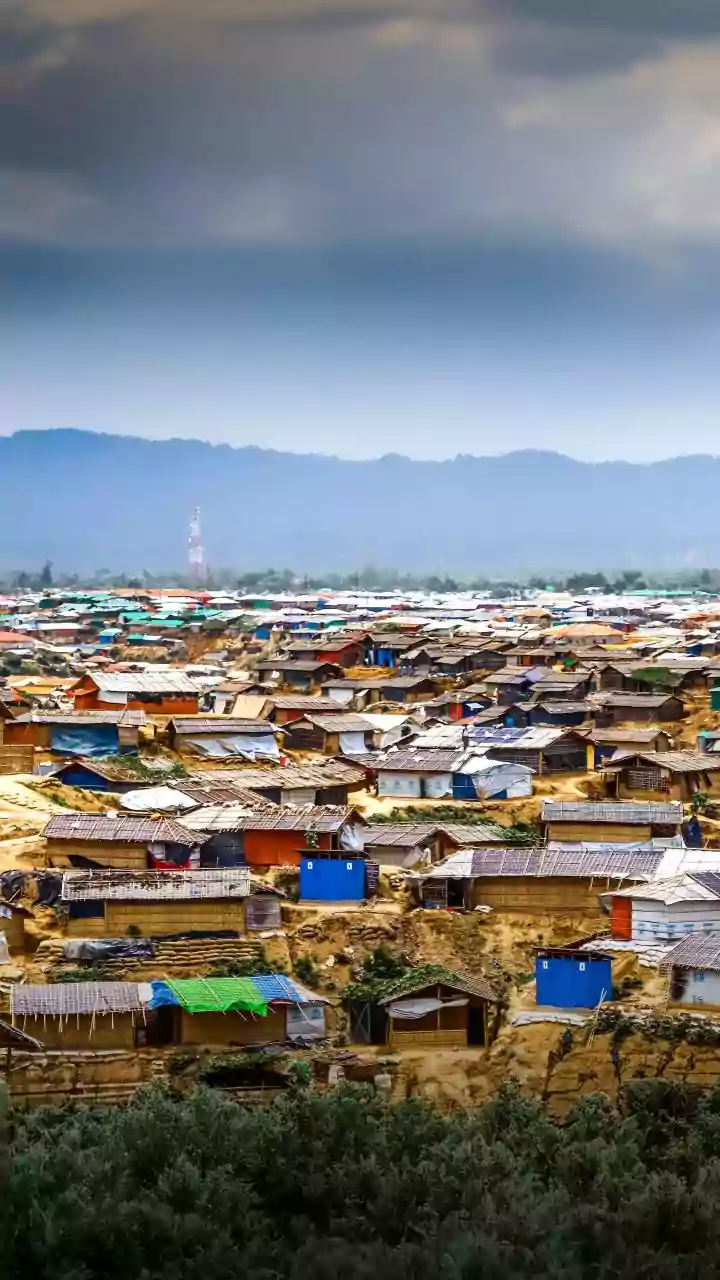
Since Myanmar also shares a 1,600 km border with India, cooperation between the two countries is being seen as crucial to maintaining stability along the border, particularly from insurgent groups.
The visit is also significant for Myanmar, as it has faced regional isolation following the ouster of the elected civilian government led by Nobel Peace Prize winner Aung San Suu Kyi, which triggered a nationwide uprising against the military.
India and Myanmar are linked through several major infrastructure and connectivity initiatives. Projects such as the Kaladan Multi-Modal Transit Transport Project and the India-Myanmar-Thailand Trilateral Highway are central to India’s Act East policy.