







Despite the US naval blockade around the Strait of Hormuz, two Iranian tankers, Hero II and Hedy, which can carry up to 4 million barrels of crude oil, sailed out of the Persian Gulf and into the Arabian
Sea. How did they do it? Does it mean the US naval blockade is ineffective? Are these the only Iranian tankers to have crossed the blockade? What is the status of the Strait of Hormuz? News18 explains.
STRAIT OF HORMUZ: OPEN OR SHUT, WHAT IS THE CURRENT STATUS?
Shipping through the strait, the primary artery for global oil and liquefied natural gas passing through Iran, has been disrupted since February 28, after the US and Israel struck Tehran. As the peace talks failed, the US announced and formally imposed a naval blockade on April 13, targeting ships linked to Iranian ports.
On April 17, Iran declared the strait “open” during a fragile ceasefire, which briefly calmed markets. But this didn’t last. By April 18, Iran warned it would close it again, and incidents like firing on vessels signalled renewed tension.
The US, meanwhile, continued to intercept ships, while traffic collapsed again, with only a handful of vessels passing and many stranded, effectively making the strait largely shut in practice despite not being officially closed.
THE US NAVAL BLOCKADE EXPLAINED
The blockadeis being managed by U.S. Central Command (CENTCOM) and focuses on specific tactical layers to control Iranian waterspace. The blockade applies only to ships departing from or docking at Iranian ports. Neutral vessels transiting the Strait of Hormuz to non-Iranian destinations (like Kuwait or the UAE) are permitted to pass, provided they are not carrying Iran-linked cargo, according to the Royal United Services Institute.
The US has asserted the right to intercept and board vessels suspected of carrying Iranian contraband anywhere in international waters, not just near the Strait of Hormuz. Navy vessels typically hail incoming ships with a standard warning: “Turn around or prepare to be boarded”. Most vessels (over 25 to date) have complied and turned back. While many initial interactions were handled via radio, direct action has begun. On April 19, U.S. Marines and the destroyer USS Spruance seized the first vessel, the Iranian-flagged Touska. On April 21, U.S. forces boarded the sanctioned tanker Tifani in the Indian Ocean, signalling that enforcement now extends far beyond the immediate Strait of Hormuz.
The Pentagon is utilising a diverse “force package” of more than 15 warships and 10,000 personnel. Assets like the USS Abraham Lincoln provide air cover and command-and-control centers.
San Antonio-class transport docks carry Marine Expeditionary Units (MEU) specialized in fast-rope boarding operations. Arleigh Burke-class destroyers use advanced sensors to track ships, while Littoral Combat Ships assist with mine-clearing duties in the strait. Over 100 aircraft, including E-2D Hawkeyes for early warning and MQ-9 drones, provide 24/7 “Maritime Domain Awareness” to identify “dark fleet” tankers.
US Central Command (CENTCOM) reports that they have directed 28 vessels to turn back or return to Iranian ports since the blockade started.
THE STRAIT ESCAPE: HOW DID THE 2 IRANIAN TANKERS SNEAK PAST?
According to a Bloomberg report, the tankers managed to slip past the ongoing U.S. naval blockade by “going dark” — that is switching off tracking systems.
Satellite tracking firms (like Vortexa) observed them crossing the U.S. blockade line around April 20.
What does going dark mean?
Tankers switch off AIS transponders (their GPS-like tracking systems) to avoid detection. This is a known tactic used by Iran’s so-called shadow fleet to evade sanctions and monitoring.
ARE THESE 2 THE ONLY IRAN-LINKED TANKERS THAT CROSSED HORMUZ?
These two ships are not isolated cases. Around 34 Iran-linked tankers have passed through the Strait of Hormuz despite the blockade. Roughly 9 million barrels of oil have already been moved by such vessels, according to reports from Lloyd’s List. Many ships are laden (carrying cargo) and heading out, indicating exports are still happening, according to Al Jazeera and other reports.
WHAT ARE THE TACTICS BEING USED?
Apart from going dark, tankers use these maritime tactics to evade detection by U.S. Central Command (CENTCOM) forces:
AIS Spoofing: Some vessels transmit fraudulent coordinates or “ghost” locations to make it appear as if they are in a different part of the ocean while they actually hug the Iranian coastline.
Fraudulent Flagging: Tankers have been caught flying “flags of convenience” from countries like Comoros, Malta, or Curacao to mask their Iranian origins and reduce the likelihood of being signaled for interception.
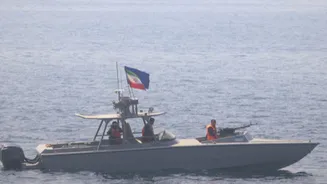
Probing the ‘Tollbooth’: Vessels often “hug” Iranian territorial waters north of Larak Island—an area dubbed Iran’s “tollbooth”—where they receive protection from Iranian gunboats and can more easily slip into the Persian Gulf’s deeper channels under the cover of night.
HOW IRAN IS COUNTERING THE BLOCKADE
The success of these tankers is also linked to Iran’s own military posture:
The Iranian Navy and Revolutionary Guard (IRGC) provide “fullsecurity and operational support” to tankers like the Silly City, which recently reached port safely despite U.S. warnings.
Iran has established its own “approved vetting routes” south of Larak Island. While the U.S. blockades ships bound for Iran, Iran has simultaneously threatened or fired on ships (such as Indian-flagged tankers) that do not comply with its own closure of the strait.
Because the strait is narrow (only 21 miles wide at points), tankers can move quickly from protected Iranian waters into the open sea, sometimes outrunning or outmaneuvering larger, slower U.S. destroyers in the congested traffic, according to various reports.
WHY DOES THE PASSAGE OF IRANIAN SHIPS MATTER?
The ability of tankers to slip through, despite a US naval blockade, shows enforcement gaps in the blockade. It also shows the continued functioning of Iran’s “shadow fleet” logistics network. This aligns with broader reporting that multiple ships have bypassed or evaded interception, despite US claims of tight control.
IRAN PRIVATELY PUSHING TO OPEN HORMUZ? WHAT TRUMP SAID ON TUESDAY
US President Donald Trump claimed that Iran is privately pushing to reopen the Strait of Hormuzto stem massive economic losses, despite Tehran’s public rhetoric suggesting a continued standoff.
Taking to Truth Social, Trump further that Iran’s outward hostility regarding the waterway is a performance intended for a political audience rather than a reflection of its financial reality.
“Iran doesn’t want the Strait of Hormuz closed; they want it open so they can make $500 million a day (which is, therefore, what they are losing if it is closed!),” Trump posted, suggesting the blockade is crippling the Iranian economy.
He further dismissed Tehran’s threats to keep the passage shut, describing them as a defensive reaction to US military pressure. “They only say they want it closed because I have it totally BLOCKADED (CLOSED!), so they merely want to ‘save face,'” the President added.
“People approached me four days ago, saying, ‘Sir, Iran wants to open up the Strait immediately,'” he claimed. “But if we do that, there can never be a deal with Iran unless we blow up the rest of their country, their leaders included!” Trump stated, underscoring his hardline approach to the ongoing crisis.
Against this volatile backdrop, the President announced late on Wednesday that he would prolong the current ceasefire to provide a window for further diplomacy.
There has been “no immediate confirmation from Iran or Israel” that they intend to honour the truce. Conversely, commentators linked to the Iranian government have cast doubt on Washington’s sincerity, framing the extension as a tactic to “gain a strategic advantage” while the “naval blockade” remains in place, say reports.
KEY FAQs
What does it mean that Iranian tankers “went dark”?
It means they switched off their AIS tracking systems to avoid detection while sailing through monitored waters.
Which tankers were highlighted in the report?
Two large crude carriers— Hero II and Hedy — were seen carrying oil past the U.S. blockade after going dark.
Does this mean the US blockade is failing?
Not entirely, but it shows gaps — Iran is still exporting oil using covert tactics and a shadow fleet.
With agency, ANI inputs