
India’s warming trend persisted in 2025, ranking it as the eighth-warmest year since 1901 with all-India annual mean land surface air temperatures 0.28°C higher than the 1991-2020 long-term average.
India
has so far experienced its warmest year in 2024 under the influence of El Niño, when the annual temperatures across India were 0.65℃ above the long-term average, followed by 2016, 2009, 2010 and 2017. The country is warming at a rate of 0.68°C per 100 years as recorded during 1901-2025. Except for the post-monsoon season, the mean temperatures were mostly above-normal for all seasons across the year, highest during winter.
Warming peaked during the winter months with seasonal mean temperatures during January and February nearly 1.17°C above normal. February was also the warmest since 1901, with mean monthly temperature nearly 1.36℃ above-normal. “Climate change has driven record-warm years for India, particularly since 2000, with winters becoming noticeably milder. In fact, we are also observing a declining trend in winter snowfall over North India, including December. Although the overall number of western disturbances has not decreased, fewer of these systems are now impacting Northwest India, and are not strong enough to trigger good winter rainfall,” said Dr Mrityunjay Mohapatra, Director General of Meteorology, India Meteorological Department (IMD).

This December too, North India was hit by eight western disturbances, but most of them were feeble and did not cause sufficient precipitation, except for the last that hit on December 30. Meteorologists say December has turned exceptionally milder in recent years, especially across Northwest India. It was ranked as the fourth-warmest in 2025 since 1901, with mean monthly temperatures 0.86℃ above-normal. Notably after 1953, Northwest India experienced four of its warmest Decembers in last 25 years—2016, 2008, 2025 and 2002—highlighting a clear warming shift.
Extreme weather events also took a massive toll, with Madhya Pradesh and Uttar Pradesh bearing the maximum brunt. As many 1,310 people died across different states due to thunderstorms and lightning, 1,370 people lost their lives in heavy rainfall and floods which ravaged large parts of North India, and heatwaves claimed over 35 lives.
MILDER WINTER AHEAD, LESS RAINS/SNOW
December ended with a staggering rainfall deficit of 68 per cent for India, despite eight western disturbances which hit North India. IMD has further predicted below-normal rainfall during January-February this year, which is likely to be less than 86 per cent of the long-period average (LPA). “It is expected that snowfall in the higher reaches of Jammu and Kashmir, Himachal Pradesh and Uttarakhand could be below-normal this winter. It may be slightly better in Ladakh, and certain patches may get normal precipitation in January,” said the IMD chief. Winter precipitation is crucial not only for the Rabi crops in the plains, but also horticulture in the hills.
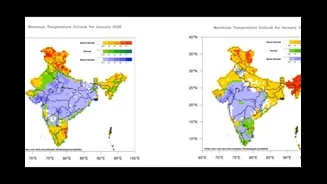
While below-normal temperatures are expected over most parts of the country, many parts of Northwest India could expect normal to above-normal day-time temperatures, indicating a milder winter ahead. Northwest India, especially the Gangetic plains are likely to see below-normal rains. The impact of cold waves could also subdued, however, above-normal cold days are forecasted for central India, eastern Uttar Pradesh, and Bihar, where dense foggy conditions persist. “This year, we experienced a higher number of foggy days. In fact, the fog persisted from December 13 to 22, and then from 23rd to 31st,” said the IMD chief.