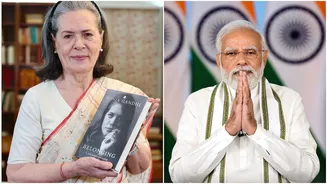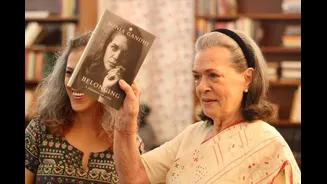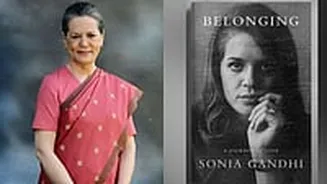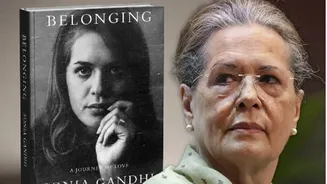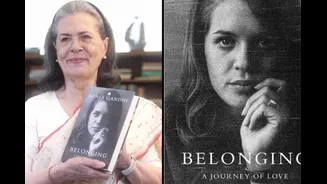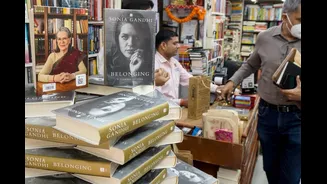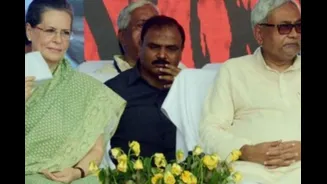



In her newly released memoir, ‘Belonging: A Journey of Love’, Congress leader Sonia Gandhi claimed that Janata Dal (United) chief Nitish Kumar was under the BJP’s influence and was constantly looking for
an opportunity to exit the opposition INDIA bloc. This assertion has triggered a sharp political row, drawing severe resentment and backlash from the JD(U).
WHAT SONIA GANDHI SAID IN HER MEMOIR
In the book, published by HarperCollins India, Gandhi recounts the tumultuous events leading up to the 2024 Lok Sabha elections. She described Nitish Kumar’s January 2024 departure to rejoin Narendra Modi’s NDA as a “premeditated” move rather than an abrupt decision. Gandhi stated that Nitish Kumar “was looking for an opportunity to exit the INDIA Bloc” rather than it being a sudden, reactive decision.
Gandhi wrote that Kumar abruptly walked out of a crucial opposition leaders’ meeting after making a “feeble excuse,” which left her with the feeling that “something was afoot”. Gandhi wrote that during this period, Kumar was operating “under the ‘control’ of the BJP”.
While she acknowledged the initial shock waves it caused within the alliance, she noted that it ultimately strengthened their determination.
Rather than framing his exit as a bitter personal feud, she contextualised his departure within “the broader challenges faced by the Opposition in maintaining unity” and the structural setbacks the alliance had to handle right before the 2024 Lok Sabha elections.
JD(U)’S STRONG REBUTTAL
The JD(U) has expressed deep grievance over how its party president was portrayed, accusing Gandhi of a calculated strategy to mislead the public. JD(U) national spokesperson Rajeev Ranjan Prasad stated that Nitish Kumar was the primary architect and driving force behind the INDIA bloc. He emphasised that it was Kumar who travelled across India to build trust and convince highly reluctant regional parties to join hands with the Congress.
Prasad reminded the public that the successful foundation of the alliance was laid entirely due to Kumar’s efforts, culminating in its first meeting in Patna. Defending Kumar’s exit, the JD(U) counter-claimed that Kumar only left after realizing that the INDIA bloc lacked the structural capacity to take on the NDA. They blamed the unbridled personal ambitions and regional political interests of the Congress and its immediate allies for the alliance’s shortcomings.
JD(U) national working president Sanjay Kumar Jha added that Gandhi’s account conveniently fails to explain the true internal circumstances and lack of consensus that ultimately forced Kumar out.