




Holi in North India is not merely a festival of colours, it is a living expression of Krishna bhakti, divine love, and centuries-old temple traditions that transform entire towns into sacred celebration
spaces. From the lanes of Braj, where Radha and Krishna’s leelas are re-enacted through Lathmar Holi and Phoolon Ki Holi, to royal temples where the festival is marked with shringar, kirtan, and Rajbhog, each destination offers a deeply immersive spiritual experience.
The festival also coincides with Gaura Purnima in the Gaudiya Vaishnava tradition, commemorating the appearance of Sri Chaitanya Mahaprabhu, who propagated the path of sankirtan, making collective chanting and devotional gatherings an integral part of the celebrations.
For devotees and cultural travellers alike, these places offer a chance to experience Holi not merely as a moment of revelry, but as a journey into living heritage, temple rituals, and the timeless joy of Krishna consciousness.
1. Barsana Radha Rani Temple – Lathmar Holi in the Land of Radha
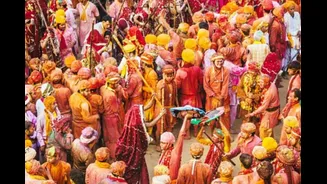
Barsana, the birthplace of Radha Rani, hosts one of India’s most iconic and culturally rich Holi celebrations, the world-famous Lathmar Holi. Days before the main festival, the town transforms into a sea of colours, devotional music, and Braj folk traditions.
The celebrations begin at the Radha Rani Temple, perched atop a hill, where priests perform special shringar and offer gulal at the lotus feet of the deity.
The highlight is the traditional re-enactment of Krishna visiting Barsana from Nandgaon, where women playfully chase men with lathis in the temple courtyard, symbolising divine love and playful leela.
Devotees sing traditional Holi songs known as samaj gayan, accompanied by dhol and nagada, creating a powerful cultural atmosphere. Flower Holi, laddoo Holi, and continuous kirtans fill the temple complex with fragrance and rhythm.
Climbing the temple steps during this time becomes a spiritual journey in itself, with chants of “Radhe Radhe” echoing throughout. The celebration is vibrant yet deeply devotional, making Barsana a once-in-a-lifetime Holi experience rooted in living Braj heritage.
2. Nand Bhavan Temple – Holi in Krishna’s Childhood Home
Nandgaon, believed to be the home of Nanda Baba and the place where Krishna spent his childhood, celebrates Holi with deep emotional and traditional fervour.
The festivities centre around the Nand Bhavan Temple, where the deity is dressed in special festive attire and ceremonially offered colours.
On the main celebration day, the people of Barsana visit Nandgaon, reversing the Lathmar Holi tradition, and the temple courtyard turns into a joyous arena of colour, music, and devotional dancing.
Priests shower gulal and flower petals from the temple balconies while Braj bhajans narrating Krishna’s childhood leelas are sung by devotees in unison.
The atmosphere here is more intimate than Barsana, yet equally powerful, with locals welcoming visitors as part of their community. Traditional sweets, thandai, and temple prasadam are distributed throughout the day.
As the sun sets, the evening aarti performed amid clouds of colour becomes a deeply moving sight, symbolising the union of devotion and celebration.
3. Banke Bihari Temple – Phoolon Ki Holi and Ras Leela in Vrindavan
Vrindavan is the heart of Holi celebrations, and the festivities at the Banke Bihari Temple set the spiritual tone for the entire Braj region.
The celebrations begin with Phoolon Ki Holi, where priests shower devotees with flower petals inside the temple, creating a fragrant and divine atmosphere. The deity is dressed in vibrant Holi attire, and special bhog is offered throughout the day.
The temple resonates with continuous kirtan, mridanga beats, and Braj Holi songs narrating the playful pastimes of Radha and Krishna.
Outside, Vrindavan’s streets become an extension of the temple celebration, with Ras Leela performances, satsangs, and devotional processions taking place at ghats and ashrams.
Devotees from across the world gather here not just to play Holi, but to experience bhakti in its most expressive form.
4. Sri Sri Rukmini Dwarkadhish ISKCON Temple – Gaura Purnima and Holi Celebrations in Delhi
Prominently known as ISKCON Dwarka Delhi, the presiding deities here are Sri Sri Gaura-Nitai, Sri Sri Rukmini Dwarkadhish, and Sri Sri Jagannath Baldev Subhadra Maharani.
ISKCON Dwarka hosts a grand two-day celebration on March 3 and 4, bringing the essence of Vrindavan to the capital.
The first day marks Gaura Purnima with Gaura Katha, abhishek of Gaura-Nitai, kirtan mela, and Chhappan Bhog.
The second day features Phoolon Ki Holi, Lathmar Holi, and Matki Phod inside a massive, well-managed pandal.
The presence of Grammy-nominated Gaur Mani Mataji for a live kirtan adds global devotional appeal.
With flower palanquin processions, a food carnival, selfie zones, and elaborate security arrangements, the celebration is designed for devotees of all age groups.
5. Govind Dev Ji Temple – Royal Holi in Jaipur
Located inside the City Palace complex, the Govind Dev Ji Temple celebrates Holi with regal grandeur that reflects Jaipur’s royal heritage.
The deity, considered the royal family’s personal deity, is dressed in elaborate Holi attire and offered special Rajbhog.
The celebrations begin with flower Holi, played in a highly organised and devotional manner within the temple courtyard.
Priests sprinkle colours and flowers on devotees while classical bhajans and kirtans are performed live.
What makes Holi here unique is the fusion of temple tradition and royal culture.
The evening aarti, performed amid chants and the soft glow of temple lamps, brings the celebration to a deeply spiritual close.