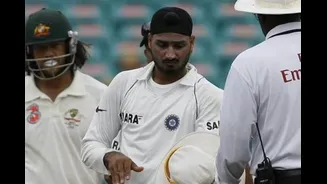

One of the most infamous controversies that shocked the cricket world occurred on this day in 2008, when a verbal altercation between Harbhajan Singh and Andrew Symonds resulted in what later came to be known
as the ‘Monkey Gate’. The incident that took place on Day 3 of the 2008 New Year’s Test between India and Australia completely marred and overshadowed the high-intense action that took place over five days.
As Harbhajan reached a hard-fought fifty in the Indian first innings in a partnership with maestro Sachin Tendulkar, a heated exchange unfolded between him and Symonds. Harbhajan was accused of having called Symonds a “monkey” during their verbal tussle.
Symonds, who was the only player of Caribbean descent in the Ricky Ponting-led Australian team, considered it a racial slur from the opposition. Notably, the middle-order star had been targeted with monkey chants during Australia’s white-ball tour of India two months before the controversy.
According to Harbhajan, however, the word he used for Symonds was a Hindi term. While offensive, the off-spinner said the term wasn’t at all intended to have racial connotations.
But when match referee Mike Procter conducted a hearing on the matter after the Test, he went in favour of Symonds based on the testimonies given by him and his teammates, including Ricky Ponting, Matthew Hayden and Michael Clarke.
Symonds later admitted that the Monkey Gate incident had a massive impact on his mental health and his game, which perhaps accelerated his decline. Player of the match in Sydney, he last played an international game for Australia less than 18 months later in May 2009.
Harbhajan, found guilty of racial abuse by Procter, was handed a three-match ban. The extensive suspension was later strongly protested by the Indian camp under skipper Anil Kumble. The Indian team argued that there was no conclusive evidence to prove that Harbhajan racially abused Symonds.
The matter further picked up heat when the Indian cricket team and the Board of Control for Cricket in India (BCCI) threatened to pull out of the remaining part of the four-match Test series as well as the tri-series to follow on the tour of Australia.
The board raised an appeal in the matter with the ICC, which led to a second hearing conducted by New Zealand High Court judge John Hansen.
Upon going through the case, Hansen downsized Harbhajan’s penalty after establishing that there was no evidence found to suggest he used a racially objectionable term for Symonds. The off-spinner’s ban was overturned and reduced to a 50 per cent fine of his match fee.
It is understood that Tendulkar’s testimony was critical in Harbhajan coming out unscathed from the allegation.
The legendary right-hander, who was there on the field when Symonds and Harbhajan engaged in a verbal battle, upheld the bowler’s argument that he used a Hindi offence instead of a racial slur. The testimony led Hansen to shift the charge from racial abuse to offensive language and downgrade the penalty accordingly.
In effect, Tendulkar played a crucial role in resolving the tension and the strained relationship between the two countries after the Monkey Gate incident was all over newspapers and TV channels and the BCCI threatened to boycott an Australian tour.
In the backdrop of the controversy, India’s historic triumph in the third Test in Perth and the tri-nation series that followed felt that much sweeter and great.