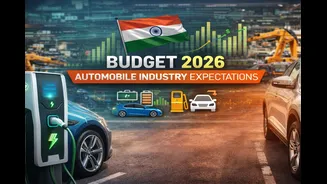

Budget 2026 Auto Industry Expectations: After GST 2.0 tax rate rationalisation, India’s automobile industry delivered a strong performance in the October–December 2025 quarter, aided by better affordability,
improving rural demand and sustained festive buying. With volumes rebounding across segments, attention has now shifted to the Union Budget 2026, scheduled for February 1.
Easier financing conditions and a recovery in consumer sentiment supported broad-based growth in passenger vehicles, two-wheelers and commercial vehicles. However, experts cautioned that rising raw material costs could pressure margins in the coming quarters.
Saurabh Agarwal, Partner and Automotive Tax Leader at EY India, said faster electric vehicle adoption, alongside a revival in internal combustion engine (ICE) demand under GST 2.0, needs consistent and balanced policy backing. “EVs continue to attract a 5 percent GST, but recent changes in ICE rates have reduced the gap. It is crucial to preserve a clear GST advantage for EVs — including for charging infrastructure, charging services and battery swapping — to keep EVs affordable and investments attractive,” he said.
He added that incentives under the PM E-DRIVE scheme should remain targeted at segments where electrification has the highest impact, such as public transport, shared mobility, commercial fleets and last-mile delivery. Rapid adoption in these areas is vital to achieve the 30 percent EV penetration target by 2030.
Big trends
- Sharp recovery in automobile volumes after GST 2.0 rationalisation
- Renewed growth across passenger vehicles, two-wheelers and commercial vehicles
- Continued strength in SUVs and premiumisation
- Rising focus on EV localisation and domestic manufacturing
Key challenges
- Rising raw material costs squeezing margins
- Shortage of rare-earth magnets affecting EV output
- Narrowing GST gap between EVs and ICE vehicles
- Dependence on imports for critical EV components
What Budget 2025 delivered
- Import duty removal on 35 key EV battery components and critical minerals
- Rs 2,819 crore allocation under the Auto PLI scheme
- Rs 4,500 crore for the PM E-Drive scheme to expand charging infrastructure
- Higher investment and turnover limits for MSMEs with enhanced credit guarantee cover
- Tax-free income slab raised to Rs 12 lakh to support demand
- R&D support for lightweight materials, advanced components and EV safety technologies
What the industry expects from Budget 2026
- Protection of GST advantage for EVs
- Continued incentives under PM E-DRIVE
- Extension of duty exemptions on critical battery inputs
- Support for domestic rare-earth magnet production
- Stronger push for localisation of EV components
- Policy continuity for both EV and ICE segments
- Sustained backing for R&D, MSMEs and supply-chain development