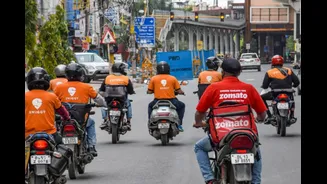

Gig Workers Strike Today: Gig and platform worker unions have called a nationwide strike today, December 31, 2025, accusing app-based companies of “systemic exclusion from core labour entitlements” and demanding
immediate government intervention to stop what they describe as widespread “exploitation” across food delivery and taxi services.
In a letter to Union Labour Minister Mansukh Mandaviya, the Gig and Platform Services Workers Union (GIPSWU) said gig workers continue to be denied basic labour protections guaranteed under Indian law and the Constitution. The union warned that failure to address these issues could have serious implications for India’s growth, pointing to a nationwide delivery workers’ strike on December 25 as an early signal of mounting discontent.
“Gig workers continue to face systemic exclusion from core labour entitlements under Indian law and constitutional guarantees. Reports document pervasive harassment, discrimination, and violence against workers. This strike unites gig workers and allies to demand immediate government intervention,” the GIPSWU said in the letter.
Why gig workers are protesting
At the heart of the protest is what unions describe as intensifying work pressure combined with falling earnings and rising safety risks. The GIPSWU, in a detailed demand charter submitted to the Labour Minister, called for an immediate end to “10–20 minute service delivery mandates”, arguing that such timelines compromise worker safety, particularly on roads during peak traffic hours.
The charter seeks a legally mandated minimum per-kilometre rate of Rs 20 for workers associated with platforms such as Zomato, Swiggy, Blinkit, Zepto, Flipkart and BigBasket. It also demands a guaranteed minimum monthly earning of Rs 40,000, workplace safety measures for women workers, emergency leave, and comprehensive maternity protection.
Other key demands include the elimination of arbitrary ID blocking and punitive rating systems, compensation for customer-initiated cancellations, exclusion of workers from opaque performance metrics, and a cap of 20% on all deductions, including auto-advance credit recoveries. The unions have also called for AI-based customer support systems to be replaced with round-the-clock human support.
Crucially, the charter emphasises that platform workers should be legally recognised as “workers” under labour laws, instead of being classified as “partners”, a practice unions say is used to deny statutory benefits.
‘Modern-day exploitation’
Shaik Salauddin, founder-president of the Telangana Gig and Platform Workers Union (TGPWU), said workers who raise concerns often face retaliation. “When delivery workers voice their concerns, platform companies respond with ID blocking, threats, police intimidation, and algorithmic punishment. This is nothing but modern-day exploitation,” he said.
“The government must intervene immediately. Regulate platform companies, stop worker victimisation, and ensure fair wages, safety, and social protection. The gig economy cannot be built on the broken bodies and silenced voices of workers,” Salauddin added.
The strike has been called jointly by the TGPWU and the Indian Federation of App-Based Transport Workers (IFAT), with support from regional collectives across Maharashtra, Karnataka, Delhi-NCR, West Bengal and parts of Tamil Nadu. According to the unions, gig workers, the backbone of India’s digital commerce ecosystem, are being pushed to work longer hours for declining pay, with little dignity or job security.
Impact on New Year’s Eve
The strike is expected to disrupt food delivery, grocery orders and last-minute shopping on New Year’s Eve, particularly in major cities such as Pune, Bengaluru, Delhi, Hyderabad and Kolkata, as well as several tier-2 markets. Delivery executives are expected to log off apps or sharply reduce availability during peak lunch, dinner and late-night hours.
Salauddin told The Economic Times that unions expect between 100,000 and 150,000 riders to participate. “The momentum is gaining very quickly. We are expecting a large number of riders to join us. We will conduct flash strikes across different cities. Some people will stop delivering food during lunch and dinner hours. Some will stop working during the peak hours when people order groceries,” he said.
What customers should know
Delivery platforms have been pushing promotional offers ahead of New Year’s Eve and advising customers to stock up. However, with deliveries not guaranteed, consumers are advised to buy essentials directly from physical stores to avoid last-minute inconvenience. Customers should also brace for longer delivery times and possible surge pricing as midnight approaches, and avoid relying on quick commerce apps for emergency purchases.