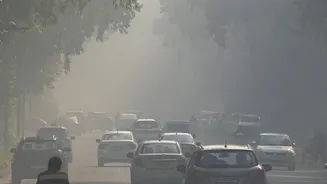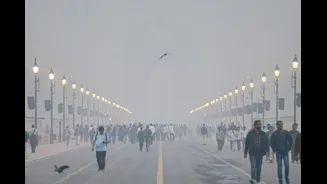

A thick layer of smog blanketed Delhi-NCR on Sunday morning, severely reducing visibility and causing discomfort to commuters. The air quality index of New Delhi was recorded at 462, categorised as ‘severe’,
at 6 am, as per data from the Central Pollution Control Board.
All 40 air quality monitoring stations across Delhi turned ‘red’, indicating ‘severe’ air quality index (AQI). Rohini in northwest Delhi recorded the worst air with an AQI of 499, followed closely by Jahangirpuri and Vivek Vihar, where the AQI stood at 495.
Visuals from the Patparganj stretch of NH-24 showed the city enveloped in a thick layer of smog. The AQI around that area was recorded at 488, categorised as ‘severe’ by the Central Pollution Control Board (CPCB).
#WATCH | Delhi | Visuals from the Patparganj section of NH-24 as a layer of toxic smog blankets the city.
AQI (Air Quality Index) around the area is 488, categorised as ‘Severe’, as claimed by CPCB (Central Pollution Control Board).
CAQM (Commission for Air Quality… pic.twitter.com/RAp43VUQ4f
— ANI (@ANI) December 14, 2025
The early morning visuals of the ITO area shared by ANI show a thick layer of smog and poor visibility, with AQI in the area recorded at 484, categorised as ‘severe’.
#WATCH | Delhi | Visuals from the ITO area as a thick layer of toxic smog blankets the city.
AQI (Air Quality Index) around the area is 484, categorised as ‘Severe’, as claimed by CPCB (Central Pollution Control Board).
CAQM (Commission for Air Quality Management) has… pic.twitter.com/4es9dICVfg
— ANI (@ANI) December 14, 2025
Gurugram, meanwhile, had lower AQI levels at 347 that was still categorised as ‘very poor’. According to the CPCB’s daily AQI bulletin, Greater Noida recorded an AQI of 444, while Ghaziabad recorded an AQI of 460, both of which are categorised as “severe”.
Commission for Air Quality Management (CAQM) has invoked all actions under GRAP Stage-IV in Delhi-NCR. According to the order, Delhi’s AQI showed a worsening trend on Saturday (December 13), rising from 431 at 4 pm to 446 by 6 pm, driven by slow wind speeds, a stable atmosphere, unfavourable weather conditions and poor dispersion of pollutants.
“Keeping in view the prevailing trend of air quality and in an effort to prevent further deterioration of air quality in the region, the CAQM Sub-Committee on GRAP decides to invoke all actions as envisaged under Stage-IV of the extant GRAP – ‘Severe+’ Air Quality (DELHI AQI > 450), with immediate effect, in the entire NCR. This is in addition to the actions under Stages I, II & III of extant GRAP already in force in NCR,” the order stated.
As per CPCB standards, an AQI of 0–50 is classified as ‘good’, 51–100 as ‘satisfactory’, 101–200 as ‘moderate’, 201–300 as ‘poor’, 301–400 as ‘very poor’, and 401–500 as ‘severe’, with each category indicating increasing pollution levels and corresponding health risks.
Saturday recorded the worst air quality of the year so far, surpassing the earlier high of 428 recorded on November 11, official data showed. The 24-hour average AQI stood at 431, with Delhi’s AQI the third worst after Noida at 455 and Greater Noida at 442, reflecting severe air pollution across the region.