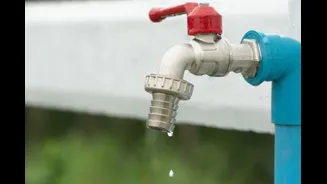

On a quiet stretch of road in south Bengaluru, water once disappeared underground for days before anyone knew why. There was no burst pipe on the surface, no flooded street, just pressure dropping in nearby
homes and tankers quietly filling the gap. Earlier, locating such leaks took nearly a week of trial digging and guesswork.
This summer, that search is happening differently. Instead of men breaking open roads, small AI powered robots are moving through Bengaluru’s water pipelines, mapping cracks from the inside and pointing engineers to the exact spot where water is escaping.
Why Water Loss Is Bengaluru’s Real Problem
As the city heads into peak summer, the biggest threat is not lack of supply alone but loss. Nearly 33 percent of treated water supplied to Bengaluru is lost due to leaks in ageing pipelines, undetected damage, and delayed repairs. For a city that depends heavily on the Cauvery river, every litre lost underground adds pressure on already stretched resources.
To tackle this, the Bangalore Water Supply and Sewerage Board has rolled out a technology led approach, placing AI driven inspection at the centre of its summer preparedness plan.
How AI Robots Are Changing the Game
For the first time, BWSSB has deployed AI powered robots to inspect water pipelines from within. These robots travel through pipelines, capture high resolution data, assess pipe health, detect leaks, and even check water quality.
Officials say faults that earlier took 5 to 6 days to locate are now being identified within 24 hours. In just the last 1.5 months, AI robots have detected leaks at more than 90 locations across the city.
The biggest shift is precision. Instead of digging up long road stretches to find a problem, repair teams now excavate only where the robot flags damage. This cuts down repair time, reduces traffic disruption, and limits the amount of water lost before fixes begin.
Where the Rs 13.56 Crore Is Being Spent
BWSSB has earmarked Rs 13.56 crore for leakage control and infrastructure upgrades across Bengaluru. In the South Division, Rs 3.95 crore has been allocated for flow meter installation and pipeline replacement. The Southwest Division has received Rs 3.96 crore for similar works.
In the Malleshwaram CJF area, Rs 3.99 crore is being spent on outlet design, MS pipeline manufacturing, and manhole construction at three pump houses. Along the Outer Ring Road near Bellandur, Rs 1.64 crore has been allocated for culvert construction near RMZ Ecospace and replacement of a 1800 mm diameter pipeline under Cauvery Fourth Stage Second Phase.
What This Means for Bengaluru’s Water Supply
According to BWSSB data, the city is currently saving around 354 MLD through leakage control and efficiency measures. Bengaluru’s total water supply capacity across Cauvery Stages 1 to 5 stands at 2225 MLD, while daily supply is around 1871 MLD.
Although 775 MLD has been earmarked under Cauvery Stage 5, only 421 MLD is currently being utilised as connections are still pending and some work remains incomplete.
Will Summer Be Different This Year
Officials say last year’s good rainfall has helped stabilise reservoirs, reducing the immediate risk of a shortage. But BWSSB officials describe the AI rollout as a preventive move, aimed at avoiding last minute crises when demand peaks.
By finding leaks faster and saving hundreds of million litres every day, the board hopes to stretch existing supplies through the summer.
For residents, the change may not be visible on the street. But underground, as robots quietly scan pipelines, less water is being lost before it ever reaches the tap.