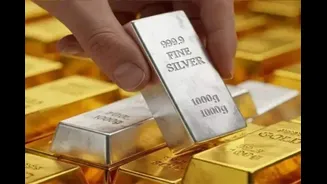

Silver has emerged as the best-performing asset class of 2025, clocking a staggering over 150 per cent rise so far this year. The rally has put the white metal on track for its strongest annual performance
in 46 years, driven by a potent mix of geopolitical risk and supply-side constraints.
In Friday’s trade, silver prices jumped 5 per cent to breach the $75-an-ounce mark for the first time. On the domestic front, MCX silver surged nearly 4 per cent to hit a record high above Rs 2,32,700 per kg.
Market participants attribute the sharp move to rising safe-haven demand amid prolonged geopolitical tensions, including the Russia–Ukraine conflict and fresh strains between the US and Venezuela. At the same time, inventory hoarding in China and the United States has exacerbated supply tightness, adding further fuel to the rally.
Is it time to book profits?
While the broader trend remains bullish, some experts are beginning to flag near-term exhaustion signals. Their caution stems largely from movements in the gold–silver ratio, a widely tracked metric that measures how many ounces of silver are required to buy one ounce of gold.
In 2025, the ratio has fallen nearly 44 per cent, from 107 to 60, highlighting silver’s sharp outperformance over gold during the year.
According to data from Kedia Advisory, the ratio is now approaching a key structural support zone near 62.5, which coincides with the 100 per cent Fibonacci retracement and historical reversal areas seen in 2016 and 2021. This, analysts say, could raise the probability of a tactical pullback.
The advisory also noted that while prices remain below the Ichimoku cloud and MACD indicators point to weakness, the RSI is approaching the 30 mark, a rare condition that has historically signalled downside exhaustion rather than trend reversal.
Rotation, not reversal
Echoing a measured view, Justin Khoo, senior market analyst – APAC at VT Market, said silver’s sharp outperformance often leads to a phase of consolidation.
“This points to rotation within precious metals, not a breakdown. Gold may regain relative leadership during periods of risk aversion, while the broader bullish structure remains intact,” he added.
Khoo added that any pullback in silver should be viewed as corrective in nature. “Inflation concerns, fiscal stress, and real-rate uncertainty remain supportive for precious metals.”
Khoo said that the sharp compression in the gold–silver ratio signals relative exhaustion in silver’s outperformance, not a reversal for the metals complex. Historically, such moves are followed by phases where gold stabilises and silver corrects. This points to rotation within precious metals, not a breakdown. Gold may regain relative leadership during periods of risk aversion, while the broader bullish structure remains intact.
“Gold’s breakout above $4,500/oz confirms strong momentum, with near-term support around $4,200–$4,300, and institutional forecasts pointing toward $4,900–$5,000 by late 2026 amid safe-haven demand and macro uncertainties. Silver, after hitting ~$72.70/oz records, may consolidate but remains structurally bullish, with many models projecting $65–$80+ through 2026 as tight supply and industrial demand persist,” Khoo added.
Ajay Suresh Kedia, the founder and director of Kedia Advisory, expects the gold-silver ratio to have a key support level of 45.232 and a key resistance level of 76.190 over the next six-month period.
Ponmudi R, CEO of Enrich Money, sees more upside potential in silver.
“MCX Silver futures are trading at all-time highs near Rs 231,000-Rs 232,000. The long-term bullish structure remains firmly intact as long as prices hold above Rs 224,000. Strong demand zones are positioned at Rs 215,000–Rs 210,000. A clean breakout above Rs 232,000–Rs 235,000 could trigger the next major leg of the rally, with upside targets opening toward the Rs 240,000–Rs 250,000 range,” he added.