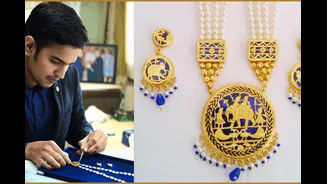








Sitting in his workshop in Rajasthan’s Pratapgarh, Raghav Rajsoni meticulously carves intricate motifs inspired by nature, mythology, and royal life onto a thin sheet of gold foil. It is the same painstaking
craft for which his late father, Mahesh Rajsoni, was awarded the Padma Shri in 2015.
28-year-old Raghav is the sixth-generation artisan carrying forward the nearly 400-year-old legacy of Thewa. This intricate art form involves fusing finely worked gold onto coloured glass and gemstones to create striking wearable and decorative pieces.
The craft demands extraordinary precision. Even a simple design measuring just 1.5 cm can take nearly three days to complete.
A 400-Year-Old Legacy Born In Royal Courts
Raghav narrates the origin story of Thewa with pride. According to family history, in the early 1700s, the King of Pratapgarh handed jeweller Nathulal Soni a few coloured glass pieces and asked him to create jewellery from them.
When Nathulal presented the finished artefact—crafted by intricately infusing gold and silver onto the glass—the king was deeply impressed and asked him about the process. It is believed that by picking letters from that process, the craft came to be known as “Thewa.”
The king also bestowed upon the artisan the title “Rajsoni,” which roughly translates to “royal jeweller.”
During the era of kings and queens, Thewa artisans were commissioned to create large decorative pieces, jewellery, and elaborate artistic objects. Even 50 to 60 years ago, Raghav’s grandfather worked on grand pieces requiring 300–500 grams of silver and 20–25 grams of gold.
Back then, entire Thewa pieces—whether jewellery or decorative art—were crafted completely in gold. But as royal patronage faded, inflation rose, and gold prices soared, artisans had to adapt to keep the craft alive and affordable.
That is when Raghav’s father began focusing on wearable art—what we now know as modern Thewa jewellery. He introduced artistic yet wearable pieces, including his famous Rani Haar—a large necklace depicting scenes of a baraat (wedding procession).
Today, while the front of a Thewa piece continues to be crafted in gold, as it was centuries ago, the back frame is often made with silver, making the jewellery more affordable while helping sustain artisans’ livelihoods.
Carrying Forward A Father’s Legacy
“When you grow up in a family of artisans, you are naturally involved in the making of art, even if not fully. It becomes a habit,” says Raghav.
“I remember coming back from school and college and helping my father in the workshop.”
As a child, however, he did not fully understand the gravity of inheriting such a legacy.
“But I saw people’s appreciation and what it meant to carry forward a craft like this,” he says.
That feeling deepened after his father received the Padma Shri. Watching people celebrate his father’s work inspired him.
At the time, Raghav was pursuing law and had not seriously considered joining the family craft professionally. But in 2019, while he was still in college, his father passed away.
“That was the moment it struck me. I had already begun thinking about taking the craft forward, but after my father passed away, there was no other option. I wanted to continue his legacy and keep the art alive in the sixth generation.”
For Raghav, every artistic piece carries a part of the artist’s soul. “All the experiences that shape an artist eventually become part of the story of the piece,” he says.
And the journey, he admits, was not always smooth. “No artist creates a perfect piece on the first attempt. I broke many pieces and ruined many designs while learning with my father.”
But perhaps the most important lesson he learned from his father had little to do with craftsmanship.
“What made my father a master artisan was his humble and down-to-earth nature,” Raghav says.
“Even after receiving the Padma award, nothing changed for him. He continued meeting customers, attending to them personally, and visiting them—just as he always had. That taught me that my nature should never change with my achievements.”
“Because, as he used to say, your nature and character reflect in your craft.”
Tradition Meets A New Generation
Many of Mahesh Rajsoni’s old customers still visit the family’s ancestral shop in Pratapgarh, often asking for the motifs he was known for.
But such requests are becoming rarer. Today’s customers want trendier designs—and that is exactly where Raghav is taking the centuries-old craft.
While designing new collections, he draws inspiration from traditional motifs and adapts them to contemporary tastes, customer preferences, and market trends—all while staying true to the original Thewa technique.
“The motif can remain the same—the internal design my father used, for example—but the outer frame, the gemstones, or the overall presentation can be modern, based on current jewellery trends,” he explains.
At the same time, younger customers increasingly approach him with custom ideas.
“Sometimes people come with their own designs and ask us to make them affordable. But there are technical limitations in the craft—customisation takes time, and that naturally increases the cost.”
“We have to consider not just the material cost, but the craftsmanship that goes into every piece.”
To make Thewa more accessible at a time when gold prices are soaring, Raghav has introduced smaller, modern pieces—minimal pendants, brooches, cufflinks, buttons, and rings, including jewellery designed for men.
“Thewa is not confined to one gender,” he says.
Like many artisan families, several members of the Rajsoni family have moved into other professions due to changing career prospects and reduced demand compared to the royal era.
But for those who wish to continue the craft, Raghav says there is strong government support.
“I got to visit Kazakhstan on my first international trip to represent the craft. It was a competition in 2023 with around 120 artisans from 12 to 15 countries, and I won an award there.”
“That motivates not just me, but also the younger members of my family. It makes you proud to represent your country and keeps the craft alive.”
He has also represented India in Paris and Moscow, promoting Thewa globally and helping preserve India’s traditional craft heritage.
For Raghav, the reward goes far beyond money. “The respect, the cultural value, and the appreciation of representing a craft that is 400 years old—that is worth far more than a salary or corporate life,” he says.
Owning A Piece Of Living Heritage
For Raghav, the elephant motif and the baraat scene remain signature Thewa elements—designs that instantly define the craft. But if you’re planning to buy Thewa jewellery, you don’t need to spend a fortune on elaborate statement pieces.
Smaller pendants, brooches, earrings, cufflinks, and rings carry the same craftsmanship and artistic precision—just in a more affordable form.
So, if you are looking to buy jewellery that can one day become an heirloom (because you don’t always have to inherit one; you can be the one to pass it on), Thewa is a compelling choice.
With Thewa, you are not just buying jewellery. You’re investing in centuries-old craftsmanship, carrying forward a rich legacy of Indian art, and contributing to the survival and growth of one of India’s most unique traditional crafts.