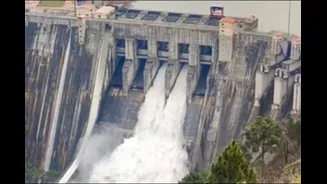

The Indian government has approved the Dulhasti-II hydroelectric project on the Chenab River in Jammu and Kashmir, prompting protests from Pakistan. The decision was cleared last month by the Union Environment
Ministry after India suspended the Indus Waters Treaty with its neighbour.
The Expert Appraisal Committee on hydel projects accorded approval during its 45th meeting in December, paving the way for the floating of construction tenders for the run-of-the-river project in J&K’s Kishtwar district, estimated to cost over Rs 3,200 crore.
Pakistan has responded sharply to India’s plans, accusing New Delhi of violating international agreements and destabilising the region. Pakistani Senator and Pakistan Peoples Party (PPP) leader Sherry Rahman was one of the most prominent critics, saying that the “weaponisation of water was neither sane nor acceptable.”
What Is Dulhasti-II Project?
Dulhasti Stage-II is an extension of the existing 390 MW Dulhasti Stage-I Hydro Electric Project (Dulhasti Power Station), which has been successfully operating since its commissioning in 2007 by the National Hydroelectric Power Corporation Limited.
Under the plan, water will be diverted from the Stage-I power station through a separate tunnel measuring 3,685 metres in length and 8.5 metres in diameter to form a horseshoe-shaped pondage for Stage-II.
The project also includes a surge shaft, a pressure shaft, and an underground powerhouse housing two 130 MW units, resulting in a total installed capacity of 260 MW and an annual energy generation. The total land requirement for the project is estimated at 60.3 hectares. This project will require 8.27 hectares of private land from two villages, Benzwar and Palmar, in Kishtwar district.
In its assessment, the Expert Appraisal Committee (EAC) on hydel projects under the Ministry of Environment acknowledged that the waters of the Chenab basin are shared by India and Pakistan under the framework of the Indus Waters Treaty of 1960 and noted that the design parameters of the project were drawn up in line with the treaty’s provisions. However, the panel also explicitly recorded that “the Indus Water Treaty stands suspended effective from 23rd April, 2025”.
Why Is Pakistan Protesting?
Under the Indus Waters Treaty, Pakistan exercised control over the waters of the Indus, Jhelum, and Chenab rivers, while India retained rights over the Ravi, Beas, and Sutlej. However, since the treaty was suspended, India is not bound by earlier procedural obligations such as prior notification to Pakistan or the routine sharing of technical data related to river flows and new hydropower projects.
After the treaty was suspended in the wake of the barbaric Pahalgam terror attack on April 22, the Centre has moved to accelerate several long-pending projects that were earlier slowed by diplomatic, technical, or legal challenges. These include major hydropower projects such as Sawalkote, Ratle, Bursar, Pakal Dul, Kwar, Kiru, and Kirthai-I and II.
“We have seen these media reports regarding Indian plans to construct the Dulhasti Stage-II hydroelectric project on the Chenab River. Obviously, these reports raise serious concerns as no prior information or notification was shared with Pakistan with regard to this project,” said Pakistan’s Foreign Ministry spokesperson Tahir Hussain Andrabi.
He also accused India of “complete disregard of international law and bilateral treaties” and said the Pakistani commissioner for Indus water has sought clarification from his counterpart in India regarding the nature, scope and technical details of the reported projects. He also insisted that India could not misuse its “restricted allowance” for unilaterally building any hydroelectric projects on the western rivers.
Sherry Rahman described it as a “serious weaponisation of the waters of the Chenab River” and warned that any unilateral action on disputed waters directly undermines Pakistan’s recognised water rights and poses serious threats to regional peace and stability.
(with agency inputs)