
Union commerce minister Piyush Goyal on Wednesday expressed optimism on a potential agreement between India and the United States as trade talks gain momentum between the two countries.
Headed by deputy
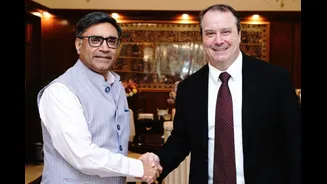
trade representative Rick Switzer, a team from the US is currently in New Delhi for discussions with Indian counterparts, including foreign secretary Vikram Misri, covering both the ongoing trade talks as well as broader economic partnership.
The path to reaching a bilateral trade agreement, however, is made complex by the US tariffs imposed on Indian goods by the Trump administration. Despite the tariff challenge, both sides are reportedly making progress towards a comprehensive pact with a focus on increasing bilateral trade and strengthening supply chains.
Officials have expressed hope for reaching at least a framework solution this calendar year, although the BTA is expected to take more time.
WHAT ARE THE KEY DEVELOPMENTS IN NEGOTIATIONS?
- US Delegation in Delhi: A US trade delegation has been present in India since Tuesday (December 9), engaged in advancing trade talks. The visit marks a renewed push towards enhanced India-US bilateral engagement. This delegation, led by deputy US trade representative (USTR) Rick Switzer, is in the national capital for two days of discussions.
- High-Level Meetings: Rick Switzer held a meeting with foreign secretary Vikram Misri. Their discussions extended beyond the ongoing trade negotiations, covering the strong India-US economic and technology partnership. They also addressed opportunities to boost two-way trade and the establishment of resilient supply chains.
- Negotiation Teams: Switzer is holding talks with his Indian counterpart, Rajesh Agrawal. The chief negotiator from the US for the pact, assistant USTR for South and Central Asia Brendan Lynch, is also involved in discussions with India’s chief negotiator, joint secretary in the commerce department Darpan Jain. Multiple rounds of discussions have already taken place between both sides.
- ‘Progressing Well’: Union commerce minister Piyush Goyal stated his optimism regarding the ongoing negotiations, confirming that discussions are “progressing well” towards a bilateral trade agreement. Speaking on the sidelines of the Rajasthani Pravasi Divas, he noted that talks have been advancing positively. He underscored the detailed nature of the negotiations, stating that: “All agreements have many diversified angles,” adding, “many dots have been connected.” He indicated he might meet the visiting US official team.
- US Acknowledges Strong Indian Offers: Separate comments from the US side indicate forward movement, particularly concerning agricultural market access. US trade representative Jamieson Greer told lawmakers that India had presented some of the “strongest trade proposals Washington had seen in years”. He noted that New Delhi had been “quite forward-leaning” in recent rounds, suggesting the country is becoming a “viable alternative market”.
- Obstacle to BTA: The road to finalising the BTA has been significantly complicated by the issue of the Trump administration’s tariffs on Indian goods. President Donald Trump imposed a 25 percent tariff on Indian goods starting August 1, which was followed days later by an additional 25 percent increase. These tariffs were instituted as part of reciprocal measures, citing India’s continued purchase of Russian oil and targeting countries where the US faces trade deficits.
- Delay in Timeline: These new developments in US trade policy, including the imposition of tariffs, led to a delay in the original target of completing the first tranche of the pact, which was initially planned for fall 2025.
- Framework Deal Needed: The US and India are currently engaged in two parallel negotiations – one focused on a comprehensive trade deal and another on a framework trade deal specifically designed to address these reciprocal tariffs. The framework deal is crucial as it aims to address the tariff challenge faced by Indian exporters.
- Impact on Trade: The imposition of these hefty tariffs by Washington has already impacted Indian exports. India’s merchandise exports to the US declined for the second consecutive month in October, falling by 8.58 percent to USD 6.3 billion. The current visit of US officials is particularly important as it is only their second trip since the imposition of the 25 percent tariff and the additional penalty.
- Overall Goal: The comprehensive agreement being negotiated aims to significantly increase the bilateral trade volume. The goal is to more than double the current bilateral trade of USD 191 billion to reach USD 500 billion by 2030. The US has been India’s largest trading partner for the fourth consecutive year.
- Other Negotiation Areas: Beyond tariffs and agricultural market access, talks also include discussions over zero-tariff commitments for civil aviation parts under the 1979 Aircraft Agreement, which are considered “fairly far advanced”.
- Confidence in Resolution: Despite the complications, the commerce secretary expressed confidence in November, stating: “I think our expectations…we are very optimistic and very hopeful that we should find a solution within this calendar year.”
(With agency inputs)