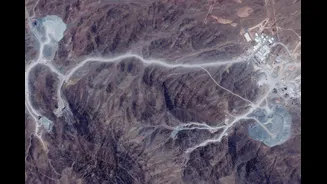










Israeli intelligence believes Iran moved thousands of uranium-enrichment centrifuges into tunnels deep inside Pickaxe Mountain last fall, raising fresh concerns that Tehran could rebuild its nuclear programme,
according to a Wall Street Journal report citing Israeli and US officials.
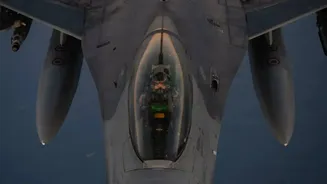
The report said Israel shared the intelligence with the United States, claiming the centrifuges were transferred to the heavily fortified site after the 12-day Israel-Iran conflict in June, during which American and Israeli strikes targeted Iran’s three main nuclear facilities.
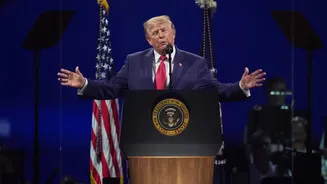
Israeli Prime Minister Benjamin Netanyahu has been urging US President Donald Trump to intensify military action against Iran to further derail Tehran’s nuclear programme and reconstruction efforts.
‘Pickaxe Is Possible Target For Nice Big Fat Shot’
Over the past 10 days, the United States has stepped up attacks, with Trump publicly identifying Pickaxe Mountain as a possible future target.
Pickaxe is “a possible target for a nice big fat shot,” Trump told conservative broadcaster Hugh Hewitt on July 13.
Trump said that Washington was prepared to strike the underground facility. “We’re going to take out Pickaxe Mountain. Tell the Iranians to be ready,” the US President said during an interview on the Hugh Hewitt Show.
Also Read: ‘We’ll Give Pickaxe A Shot’: Trump Threatens Strike On Iran’s Underground Nuclear Site, Tehran Hits Back
“We’re watching (Pickaxe Mountain) closely. We see no activity there. They’re not doing well with their nuclear situation. Every time we hear about it, we blow it up. So they don’t like talking about it. But we’ll probably give Pickaxe a shot relatively soon,” he added.
It was the first time Trump explicitly identified Pickaxe Mountain as a potential target, although he had previously referred to an underground Iranian nuclear site buried beneath granite.
What Is Pickaxe Mountain?
Located near Iran’s heavily damaged Natanz uranium enrichment facility, Pickaxe Mountain, known in Iran as Mount Kolang, is a heavily fortified complex with two deeply buried tunnel networks that experts believe are beyond the reach of even the most powerful US bunker-buster bombs.
The site has been monitored by the United States and Israel for years. It was commissioned as an underground replacement for an Iranian centrifuge assembly facility damaged in a 2020 explosion, widely suspected to have been an act of sabotage.
Also Read: What Is Pickaxe Mountain? Iranian Nuclear Site Trump Wants To Take Out With ‘Big, Fat Shot’
Although Pickaxe was not considered a priority target during last year’s Israel-Iran conflict and has not been struck in the latest round of fighting, activity at the site has continued over the past 15 months.
Is Iran Rebuilding Its Nuclear Programme?
According to the Institute for Science and International Security, truck traffic, tunnel reinforcements and expanded security infrastructure have all been observed. Work has also continued around an older tunnel network dating back to 2007 that Iran has since sealed.
Officials and experts have long expressed concern that Iran could use the tunnels to store or manufacture nuclear equipment or establish a small uranium enrichment facility capable of producing fissile material.
An Israeli military official familiar with the targeting effort said the recent airstrikes did not sufficiently degrade Iran’s nuclear weapons-related work and suggested further action, including against Pickaxe Mountain, may be necessary.
Centrifuges are machines used to spin uranium gas, separating isotopes to enrich the material for civilian nuclear energy or potential weapons production.
No Access To Iran’s Nuclear Sites
Iran has consistently denied seeking nuclear weapons, although it has produced about 1,000 pounds of uranium enriched to 60 per cent, close to weapons-grade.
Following the June 2025 strikes, Tehran may have relocated surviving centrifuges to the underground complex to reduce the risk of further destruction.
While spare machines may have been stored at Iran’s main nuclear sites, the International Atomic Energy Agency (IAEA) has said Iran has denied inspectors access to Pickaxe and provided no information about activities at the site.
IAEA Director General Rafael Grossi said in March that Iran had announced in 2021 its “intention to have nuclear activity” at the facility.