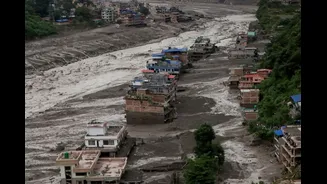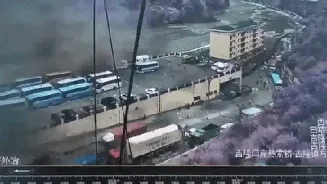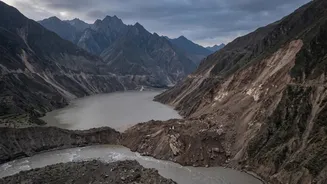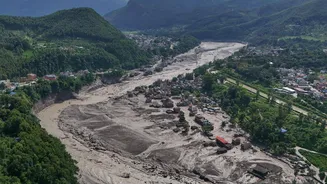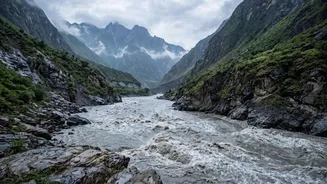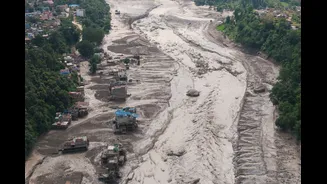






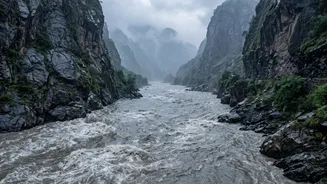

An information delay of 16 minutes in Nepal’s early warning system is believed to have directly shaped the human cost of the catastrophic August 2026 Himalayan flash floods. Triggered by a massive glacier-related
collapse near the Tibet border, a wall of ice, rock, and mud tore through the river valley faster than local monitoring stations could report it. The narrow warning window proved to be a deciding factor between survival and tragedy for communities downstream, according to Economic Times, Firstpost and other reports.
WHY THE 16-MINUTE DELAY?
The 16-minute delay in Nepal’s early warning system was caused by a complete lack of cross-border data sharing paired with the extraordinary speed of the disaster.
The catastrophic surge crossed the Tibet-Nepal border at Rasuwagadhi at 8:40 AM. Nepal’s Department of Hydrology and Meteorology (DHM) did not receive any information until 8:56 AM — 16 minutes later — when the Rasuwa District Administration Office manually routed a report through the National Disaster Risk Reduction and Management Authority (NDRRMA).
By the time the warning system logged the event, the fast-moving wall of water had already traveled 14 kilometers downstream in just 10 minutes, destroying upper valley settlements like Syabrubesi before an alert could be sent.
Because automatic stations in the upper basin stopped transmitting before they could alert officials, upper Rasuwa communities received no SMS alerts before the water arrived. Residents had to rely on impromptu whistles and shouts to escape, say reports.
HOW THE EARLY WARNING SYSTEM WORKS
Nepal’s standard flash flood warning system operates through a structured, multi-step sequence that relies heavily on upstream telemetry:
- Upstream River Gauges/Sensors
- DHM Central System (Kathmandu)
- Mass Automated SMS Dispatches via Telecom Networks
- Local Evacuation & Community Sirens
WHY IT FAILED
Here is exactly why this framework failed during the disaster:
No Trans-Boundary Sensors: The trigger event — a massive ice-rock avalanche — occurred in a remote area near the border. Nepal’s river gauges are stationed entirely within its own borders. Because there was no live automated data exchange with Chinese monitoring networks, Nepal had zero visibility into the upper basin.
Velocity Overwhelmed Infrastructure: Traditional flood alerts assume a steady, rainfall-driven river rise over several hours. This was a sudden, hyper-velocity wall of mud and boulders. The torrent moved faster than human administrative networks could process the incoming field reports.
Immediate Uplink Destruction: Mountain tracking stations located right at the border crossing were instantly destroyed or buried by the leading edge of the mudslide, stopping automatic data transmissions before an automated threat level could trigger.
Experts from organizations like ICIMOD and local hydrologists point to a critical gap in cross-border, real-time data sharing. Because the glacier collapsed right at the border, the surge entered Nepalese territory before information could be routed through regional administrative networks, highlighting an urgent need for automated, interconnected mountain sensors across international boundaries, say reports.
HOW IT HELPED DOWNSTREAM
While the 16-minute lag was fatal for the upper valley, the automated system worked exactly as intended for downstream communities once the DHM processed the 8:56 AM alert.
Before 9:00 AM, the DHM pushed out over 600,000 mass SMS alerts to mobile towers operating further down the Trishuli River basin.
At the Tribhuvan Trishuli Secondary School in Nuwakot, school administrators received the automated disasterbroadcast right during morning assembly. This gave teachers a vital buffer window to march hundreds of students up to higher safety zones.
Shortly after the school evacuated, the Trishuli River surged by 9 meters (30 feet) in under 30 minutes. While infrastructure and low-lying buildings were crushed, the targeted mobile broadcast effectively averted a massive loss of life in the lower valley, say reports.