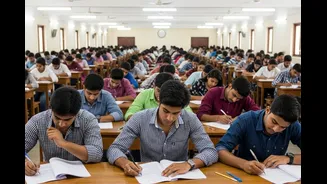

The JEE (Main) paper held on January 22, 2026 (morning shift) was considered moderately difficult by students and experts. Of the three sections, Physics was the easiest, followed by Chemistry, while Mathematics
was more challenging.
“The JEE (Main) paper conducted on January 22, 2026 (Morning Shift) was of moderate to difficult level. Among the three sections, Physics was the easiest, followed by Chemistry, while Mathematics was relatively more challenging. Overall, the paper was balanced and comparable to last year’s papers in terms of both difficulty level and pattern. The distribution of questions across topics was largely uniform,” Ajay Sharma, National Academic Director, Engineering, Aakash Educational Services Limited stated.
Questions in the Mathematics section were fairly spread across the syllabus. Topics from Calculus, Conic Sections, and Algebra had higher representation, whereas 3D and Vectors and Complex Numbers appeared less frequently. Algebra was slightly dominant, and Coordinate Geometry had moderate weightage.
Most students found the Physics section easy. Nearly all major chapters were covered, though Class XI topics like Mechanics had fewer questions, and Rotation was absent. Chapters such as Waves and Thermodynamics were included but had lesser weightage. Conversely, Class 12 chapters were more prominent with numerous questions from Optics, Electromagnetism, and Modern Physics. A few questions also came from Waves and EMI.
The Chemistry section ranged from moderate to difficult. Questions covered all three areas—Organic, Inorganic, and Physical Chemistry. Inorganic Chemistry was more prevalent, with several questions from the p-block. Organic Chemistry focused on properties and name reactions, while Physical Chemistry included questions from Electrochemistry, Equilibrium, and Thermodynamics.
The JEE Main 2026 started on January 21. According to students, the overall difficulty level of Shift 2 JEE Main on Wednesday was moderate. The Physics paper ranged from easy to moderate, Chemistry was moderate, and Mathematics was moderate to high. In Shift 1, Mathematics was moderate but time-consuming, with most questions from topics like Vector 3D, Sequence and Series, and Quadratics. Chemistry was lengthy and difficult, with many candidates reporting it took about an hour to complete; notably, six to seven questions were statement-based. Physics was also described as moderate, with questions from areas like wave optics, kinematics, and thermodynamics. Overall, the paper required careful time management in all three subjects.