




As Bangladesh approaches yet another defining political transition, the country has become the centre of an unusual and consequential diplomatic experiment. Over the past year, Washington has intensified
its engagement with Bangladesh’s Islamist parties, most prominently Jamaat-e-Islami (JeI) and Islami Andolan Bangladesh (IAB). What began as a series of low-profile interactions has now evolved into an unmistakable policy shift—one that signals a strategic recalibration with the potential to reshape South Asia’s political and security landscape in deeply unsettling ways.
The Biden and Trump administrations may disagree sharply on domestic politics and global priorities, but on Bangladesh, they appear to have converged on a shared assumption: Islamist parties will command a larger share of power in Dhaka’s future, and the United States must therefore engage them directly. This outreach, however, is unfolding at precisely the moment when Bangladesh is at its most politically fragile, and when Islamist revivalism is at its most assertive since the early 1990s.
The risk is stark. Washington may be placing a calculated bet on forces whose rise could intensify regional instability, embolden extremist networks, and erode the secular foundations of the Bangladeshi state—foundations laid through immense sacrifice during the Liberation War of 1971.
A Sudden Pivot In Washington’s Bangladesh Policy
The shift did not arrive with a formal announcement; it crept in quietly. Earlier this year in Sylhet, officials from the US embassy held a meeting with leaders of Jamaat-e-Islami’s regional unit—an organisation historically linked to collaboration with the Pakistani army during the genocide of 1971. That meeting was followed by a string of increasingly public engagements: a US diplomat meeting a Jamaat leader at the American Club; former US ambassadors visiting Jamaat’s headquarters; an embassy-hosted Jamaat “delegation” discussing internal democracy and minority rights; and, most strikingly, a high-profile July visit by US chargé d’affaires Tracey Ann Jacobson to Jamaat’s central leadership.
To many Bangladeshis, the symbolism was unmistakable. These were not neutral interactions but signals indicating that Washington now views Jamaat as a legitimate political stakeholder.
The message became even clearer with the issuance of a US visa to Jamaat’s ameer, Shafiqur Rahman, despite his long record of incendiary rhetoric targeting Jews and his recent praise for Hamas commander Yahya Sinwar. Rahman’s meetings in New York, Buffalo, Michigan, and Washington DC cemented the impression that a once-isolated Islamist movement had suddenly found acceptance in Western policy circles.
The Underlying Logic And A Dangerous Misreading
What explains this dramatic recalibration?
Three interlinked calculations appear to be driving Washington’s approach.
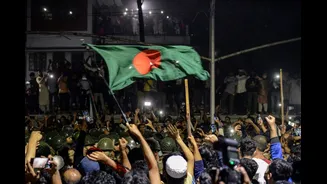
First, a transformed political map in Bangladesh. The 2024 uprising that removed Sheikh Hasina created a vacuum. The interim administration led by Muhammad Yunus has granted unprecedented political space to Islamist factions that were previously marginalised by court rulings and electoral constraints. Washington seems eager to adapt to this new reality—perhaps too eagerly, and without sufficient regard for Bangladesh’s historical traumas.
Second, the familiar Western belief in “moderation through engagement”. From Egypt’s Muslim Brotherhood to Tunisia’s Ennahda, American policymakers have repeatedly argued that Islamist movements soften once integrated into formal politics. Yet the empirical record suggests otherwise. In most cases, Islamists use democratic entry points to entrench power, narrow civic space, and marginalise dissent.
Third, geopolitical competition in the Bay of Bengal. With China deepening its footprint in Bangladesh’s ports, infrastructure, and defence partnerships, Washington may see political inclusivity—even with Islamists—as the price of retaining influence in a strategically vital theatre.
But in making this gamble, the United States appears to be misreading the ideological depth and long-term objectives of the actors it is courting.
Islamist Mainstreaming And The Shrinking Of Secular Space
Inside Bangladesh, Islamist groups are experiencing a rapid and confident mainstreaming. Jamaat and IAB, emboldened by the interim government’s permissive posture, have re-entered public life not as chastened reformists but as assertive moral arbiters.
This mainstreaming extends beyond electoral politics. It coincides with a visible contraction of Bangladesh’s secular civic space. Human rights groups and journalists have documented a resurgence of communal violence, particularly against Hindu communities. Jihadist networks that were previously contained through sustained counter-terror operations have shown signs of revival. Calls for stricter blasphemy laws and censorship have grown louder. Vigilante groups linked to Islamist student wings have re-emerged in several districts.
In such an environment, Washington’s outreach risks reinforcing the very forces undermining Bangladesh’s pluralistic character.
A Global Scramble And India’s Mounting Concerns
Bangladesh’s transition has triggered a diplomatic scramble. According to local reporting, envoys from more than 35 countries—including China, Russia, Turkey, Saudi Arabia, the UK, Japan, Iran, Pakistan, and multiple EU states—have engaged Jamaat or its allies over the past year. The breadth of this outreach reflects a shared expectation: Islamist parties may soon be kingmakers, if not coalition leaders.
For India, the implications are severe. A Jamaat- or IAB-influenced government in Dhaka could amplify cross-border radicalisation, energise extremist networks in West Bengal and Assam, reopen strategic space for Pakistan’s ISI, complicate counter-terror cooperation, revive Rohingya-linked insurgent pathways, and increase pressure on Hindu communities along the border.
China and Turkey, by contrast, may see opportunity. Beijing offers patient capital without ideological conditions. Ankara perceives ideological affinity. Pakistan sees a long-awaited chance to reinsert itself into Bangladesh’s political equation.
In this crowded field, Washington’s approach increasingly resembles a reactive scramble rather than a coherent strategy.
A Familiar, And Costly, Historical Pattern
The US experiment in Bangladesh echoes a recurring Western error: the belief that Islamist movements can be safely domesticated through early engagement.
The Middle East offers sobering lessons. In Egypt, the Muslim Brotherhood sought institutional capture. In Tunisia and Libya, Islamist factions deepened fragmentation. In Yemen, US-backed engagement with Al-Islah produced catastrophic unintended consequences. Yet institutions such as the National Democratic Institute and the International Republican Institute continue to pursue this doctrine across the developing world.
Bangladesh now risks becoming the next proving ground for a theory that has failed repeatedly.
The Stakes Could Not Be Higher
Should Jamaat, IAB, and their allies gain substantial influence, several outcomes appear likely: harsher blasphemy and censorship regimes; accelerated communal violence; deeper alignment with Turkey and Pakistan; increased jihadist recruitment; rollbacks in women’s rights; and a fresh wave of radicalisation across India’s eastern borderlands.
For South Asia and the Bay of Bengal, the strategic fallout would be profound.
What Washington frames as inclusive diplomacy may ultimately legitimise the most regressive forces in Bangladesh’s political ecosystem. Bangladesh is not just another developing democracy; it is a critical buffer against radicalisation, a key maritime actor, and a pillar of regional connectivity.
Bangladesh stands at a crossroads. And the choices foreign powers make today will determine whether South Asia moves towards stability or drifts into a new era of ideological confrontation—with consequences far beyond Dhaka.
The writer is a technocrat, political analyst, and author. He pens national, geopolitical, and social issues. His social media handle is @prosenjitnth. Views expressed in the above piece are personal and solely those of the author. They do not necessarily reflect News18’s views.