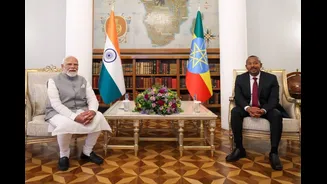









India and Ethiopia have entered a new chapter in their long-standing relationship, with Prime Minister Narendra Modi’s maiden bilateral visit to Addis Ababa marking a significant moment of diplomatic elevation.
The visit saw the two countries upgrade their engagement to a ‘Strategic Partnership’ , sign a set of new agreements, and emphasise people-centric development as the organising principle of future cooperation.
PM Modi was also conferred Ethiopia’s highest civilian honour, The Great Honour Nishan of Ethiopia, becoming the first global head of state to receive it. This follows a series of state honours he has received from African nations in recent years, including decorations from Nigeria, Mauritius, Ghana and Namibia.
Grateful to the people and Government of Ethiopia as well as Prime Minister Abiy Ahmed Ali for conferring upon me the ‘Great Honour Nishan of Ethiopia’ last evening. To be honoured by one of the world’s most ancient and rich civilisations is a matter of immense pride. This honour… pic.twitter.com/MWrdGwVFcI
— Narendra Modi (@narendramodi) December 17, 2025
The visit featured cultural diplomacy as well, including a rendition of Vande Mataram sung by Ethiopian singers, a gesture PM Modi described as “deeply moving.”
These developments come as India and Ethiopia navigate a broader upswing in ties shaped by long historical linkages, expanding development cooperation, strong trade and investment ties, and growing engagement within regional and global platforms. The upgrade to a Strategic Partnership formalises this momentum and aligns the relationship with India’s wider Africa outreach.
During his address to Ethiopia’s Parliament, PM Modi positioned India’s democratic and economic trajectory as a model for South–South cooperation, drawing on shared anti-colonial experience and India’s long-standing partnership with Africa.
It was a great honour and privilege to address the Ethiopian Parliament this morning. Ethiopia’s rich history, culture and spirit inspire deep respect and admiration. I conveyed India’s commitment to further strengthening our partnership, guided by shared values, mutual trust and… pic.twitter.com/pxvvvrZ083
— Narendra Modi (@narendramodi) December 17, 2025
How Have India–Ethiopia Ties Evolved Over Time?
India and Ethiopia share one of the oldest recorded relationships in Africa, with documented links going back nearly 2,000 years. Trade flourished during the Axumite Empire, when Indian merchants exchanged silk and spices for Ethiopian gold and ivory through the ancient port of Adulis. Over the centuries, Indians from Goa and later Gujarat became part of Ethiopia’s social and commercial landscape.
Indian soldiers, too, contributed significantly to Ethiopian history: over 13,000 Indian troops took part in the 1868 expedition to free hostages at Makdala, and Indian divisions were involved in ending Italian occupation between 1936 and 1941.
Formal diplomatic ties began soon after India’s independence. A goodwill mission led by Sardar Sant Singh visited Ethiopia in the late 1940s, and diplomatic relations were established at the legation level in 1948. Full ties followed in 1950 with Sant Singh appointed as the first Ambassador.
Since then, the relationship has expanded across political, economic, defence and cultural arenas. High-level engagement has intensified in recent years: according to the MEA, Modi and Ethiopian Prime Minister Abiy Ahmed Ali have met on the sidelines of global forums such as the BRICS and G20 summits to discuss cooperation in technology, skilling, trade, defence, and agriculture.
Ethiopia has also participated in India-chaired Voice of the Global South Summits. External Affairs Minister S. Jaishankar has visited Addis Ababa multiple times, holding discussions on bilateral cooperation, regional developments and multilateral coordination within the African Union and the United Nations.
What Were The Key Outcomes Of PM Modi’s Visit?
PM Modi’s visit to Ethiopia, the second leg of his three-nation tour, produced a series of agreements that both sides have described as substantive steps forward. The countries signed three MoUs in the areas of UN Peacekeeping Operations Training, Mutual Administrative Assistance in Customs Matters, and the establishment of a Data Centre at Ethiopia’s Ministry of Foreign Affairs.
They also announced the decision to elevate ties to a Strategic Partnership, expand scholarships through the Indian Council for Cultural Relations, introduce AI short courses for Ethiopian learners, and strengthen cooperation in maternal and neonatal healthcare.
PM Modi said these outcomes represent “significant steps forward in our longstanding and trusted partnership.” He added that from governance and peacekeeping to digital capacity and education, “the focus remains on empowering people.”
He further said the emphasis on “knowledge, skills and innovation underscores our shared faith in youth as the drivers of tomorrow,” and noted that cooperation in healthcare reflects “a deeper commitment to human dignity and care for the most vulnerable.”
Cultural diplomacy also featured prominently. At a banquet hosted by Ethiopia’s Prime Minister, three Ethiopian singers performed Vande Mataram. Modi wrote on X: “At yesterday’s banquet dinner hosted by Prime Minister Abiy Ahmed Ali, a wonderful rendition of ‘Vande Mataram’ was sung by Ethiopian singers. It was a deeply moving moment, that too at a time when we are marking 150 years of ‘Vande Mataram’.”
At yesterday’s banquet dinner hosted by Prime Minister Abiy Ahmed Ali, a wonderful rendition of Vande Mataram was sung by Ethiopian singers. It was a deeply moving moment, that too at a time when we are marking 150 years of Vande Mataram. @AbiyAhmedAli pic.twitter.com/TeHbPzBBLb
— Narendra Modi (@narendramodi) December 17, 2025
What Does The Upgrade To A Strategic Partnership Signify?
The elevation to a Strategic Partnership signals a formal recognition of the expanding scope of India–Ethiopia relations. It aligns existing cooperation in areas such as trade, development, defence, agriculture, education and technology under a more structured framework.
Defence cooperation has grown steadily, with a defence MoU signed in 2025 and the first Joint Defence Cooperation meeting held in New Delhi the same year. Ethiopia has also engaged with India through institutions linked to security and governance, including forensic training for the Ethiopian federal police and defence dialogues during international events such as Aero India.
Ethiopia’s role as host to the African Union headquarters further enhances the multilateral dimension of the partnership. Both countries regularly consult on AU matters, UN coordination and South–South cooperation. Ethiopia’s participation in the Voice of the Global South Summits, chaired by India, underscores shared positions on global governance and development issues.
The Strategic Partnership also reflects the growing role of Indian industry in Ethiopia, where more than USD 5 billion in investments — particularly in manufacturing and pharmaceuticals — have generated over 75,000 jobs.
The upgrade, therefore, reflects accumulated engagement across political, security, economic and multilateral domains.
How Significant Are Trade And Investment Ties Today?
India and Ethiopia enjoy strong economic ties. India was Ethiopia’s second-largest trading partner in 2023–24, with bilateral trade reaching $571.52 million. Indian exports amounted to $489.59 million, consisting mainly of primary and semi-finished iron and steel products, pharmaceuticals, machinery, instruments and metal manufactures. Ethiopia’s exports to India totalled $81.93 million and included pulses, vegetables and seeds, leather, spices and precious or semi-precious stones.
Investment ties are equally substantial. Around 650 Indian companies have licensed investments exceeding $5 billion in Ethiopia, with approximately $3 billion realised. These investments span agriculture, floriculture, cotton and textiles, manufacturing, engineering, plastics, water management and consultancy services.
Development cooperation has also grown. Ethiopia is among the largest recipients of India’s long-term concessional credit in Africa, with more than $1 billion sanctioned for projects in rural electrification, sugar industry development and railways. These initiatives, along with grants and technical assistance, align with Ethiopia’s development priorities.
How Important Are People-To-People And Cultural Ties?
People-to-people linkages have long anchored bilateral ties. Indian communities have been present in Ethiopia since the late 19th century, and, as the MEA notes, tens of thousands of Indian teachers served in Ethiopia during the imperial era. This legacy continues today, with around 150 Indian faculty members in Ethiopian universities and higher educational institutions. The diaspora, estimated at about 2,500, remains active in education, business and cultural life.
Cultural exchanges in 2025 reflected the depth of these ties. The Embassy of India in Addis Ababa organised a wide range of cultural initiatives, including celebrations of festivals such as Onam, Janmashtami, Ganesh Chaturthi and Rath Yatra, yoga sessions, environment-day activities, literary events and commemorations like Vishwa Hindi Diwas, all of which reinforced cultural engagement between the two countries.
Where Do India–Ethiopia Ties Go From Here?
The Strategic Partnership, the MoUs exchanged, and Ethiopia’s decision to confer its highest award on PM Modi all point to a relationship on an upward trajectory. Both sides have identified growth, technology, digital infrastructure, skilling, health, defence and trade as areas where cooperation will deepen further.
Multilateral engagement will shape the future of the partnership as well. With Ethiopia now a member of BRICS, the two countries have an additional forum for coordination alongside their existing engagement through the African Union, the United Nations and South–South platforms.