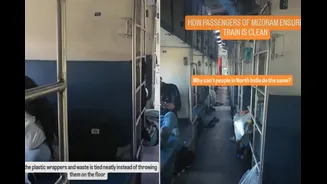









Indian Railways often faces criticism for dirty coaches, but cleanliness isn’t just the responsibility of railway staff; passengers play a crucial role too. A recent journey from Aizawl to Guwahati highlighted
this perfectly. A traveller from North India shared how, in a general coach on this North East route, the coaches remained surprisingly clean. Instead of tossing waste on the floor, passengers neatly tied the garbage in small bags and hung them by their seats, setting an example.
In the North East, respect for cleanliness extends beyond homes into public spaces. Public spaces are treated with the same care as personal spaces. This small act highlights a bigger question about personal responsibility and how people see the shared environment.
Clean Trains Show Passengers’ Responsibility
Sharing his experience on Instagram, the traveller wrote, “I was on a train from Aizawl to Guwahati, and one thing immediately stood out. These trains were incredibly neat and clean, even the sleeper coaches looked well-maintained and cared for. But what really caught my attention was something small yet powerful. People were tying their waste in small bags and hanging them neatly beside their seats. No announcements. No instructions from the railways. Just a habit. This wasn’t cleanliness enforced by rules or fines. It came from within. For people in the North East, cleanliness is not limited to their homes. It extends naturally to public spaces, shared transport, and places that do not technically belong to them.”
“A train is treated with the same respect as a living room. As someone from North India, this made me reflect deeply. We often complain about dirty trains and roads, but rarely question our own behaviour. Clean spaces do not stay clean because of the authorities alone. They stay clean because people choose to care. There is so much to learn from Mizoram and the North East. Respect for public spaces is not a campaign. It is a way of life,” he added.
View this post on Instagram
Users Praise Civic Sense
Reacting to the post, a user wrote, “Seriously, northeast is way ahead.”
Another shared, “Great to look at people having civic sense.”
“Most of the People who come northeast from other parts have started littering here and there and it’s really heartbreaking,” a comment read.
An individual stated, “Like charity, cleanliness also begins at home. We Indians keep holding GOI accountable for providing facilities, but when will we all become accountable for cleanliness and discipline?”
Another mentioned, “Every part of Northeast India shows you how good people truly are and how deeply rooted, respectful, and beautiful the culture is.”
One more added, “As life standards are improving, we should ensure that our Train, home, Cars and society around is kept clean. Cleanliness around us helps in clean thinking, accountability and a good future for our generation next – let us all contribute in making this happen.”
Vande Bharat Sleeper To Boost East North East Travel
The first Vande Bharat Sleeper train is set to soon operate between Guwahati, Assam, and Howrah, West Bengal. This vital route connects Eastern India with the North East and is used daily by students, office workers, businesspeople, and families. The train will feature 16 modern coaches and accommodate over 800 passengers at a time. Currently, trains like the Saraighat Express take over 17 hours to cover the nearly 966-kilometre journey between these regions. With the Vande Bharat Sleeper, this travel time is expected to reduce to around 14 hours.