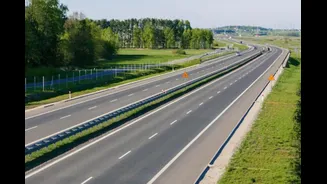







The proposed greenfield expressway aimed at significantly reducing travel time between Pune and Bengaluru is steadily moving towards final approval. The ambitious infrastructure project has already been
included among 25 priority greenfield highways identified across the country, signalling its importance at the national level.
The central government is currently in the final stages of clearing the project, with approval likely within the next month. Once the green signal is received, the process of land acquisition will begin immediately, followed by the commencement of construction work. Authorities have already submitted the detailed project report for final review.
Travel Time To Be Cut By Half
At present, the journey between Pune and Bengaluru via National Highway 48 takes around 14 to 15 hours due to heavy congestion, encroachments, narrow stretches, and frequent accidents.
The new expressway is expected to transform connectivity, reducing travel time to nearly seven hours, offering a faster and more efficient alternative.
Route And Key Districts Covered
The proposed highway will strengthen connectivity between Maharashtra and Karnataka. It will pass through key districts such as Satara and Sangli in Maharashtra, before entering Karnataka through Belagavi. From there, it will extend across Bagalkot, Gadag, Vijayanagar, Davanagere, Chitradurga, and Tumkur, eventually reaching Bengaluru.
A proposed ring road at Kanjale-Khopegaon will be integrated with the expressway, enhancing regional connectivity. The project is expected to play a vital role in boosting the Mumbai-Pune-Bengaluru industrial corridor, facilitating smoother movement of goods and strengthening trade networks between major economic hubs.
Project Specifications And Cost
The greenfield expressway, part of the Bharatmala Project, will span approximately 700 kilometres. It is planned as a six-lane highway, expandable to eight lanes in select stretches.
The estimated cost of the project ranges between Rs 45,000 crore and Rs 50,000 crore, and it will require around 20,000 acres of land.
Villages To Be Affected In Sangli District
In Sangli district, the expressway will pass through several villages across multiple talukas. In Khanapur taluka, areas such as Mahuli, Valkhad, Vaijegaon, Bhendwade, Salshinge, Jondhalkhindi, Madhalmuthi, Vasumbe, Renavi, Revanagaon, Ghoti Budruk, Ghoti Khurd, Shirgaon, Hatnoli, Bastawade, Sawalaj, Vajrachaunde, Manerajuri, and Gavan will be impacted.
In Tasgaon taluka, the route includes Kacharewadi, Narsewadi, Kindarwadi, Vijaynagar, Ped, Morale, and Manjarde. In Kavathe Mahankal taluka, the highway will pass through Borgao, Malangaon, Haroli, Deshing, Banewadi, Shindewadi, Kuktoli, Rampurwadi, and Kognoli.
Meanwhile, in Miraj taluka, villages such as Salgare, Belanki, and Santoshwadi are expected to fall along the proposed alignment.
The project has drawn attention from farmers and local communities, particularly in regions where land acquisition is expected. Many are closely monitoring developments, especially alongside ongoing discussions around other major infrastructure initiatives like the Shaktipeeth highway.
Economic Impact And Development Prospects
Once completed, the expressway is expected to significantly enhance connectivity, reduce travel time, and improve logistics efficiency. It is also likely to stimulate industrial growth, boost trade, and generate employment opportunities. Improved access to rural areas along the route is anticipated to accelerate broader economic development in both states.
Union Minister Nitin Gadkari recently reviewed the progress of the project, underlining its importance in the country’s infrastructure expansion plans.