





Mumbai’s dispute over the Maharashtra government’s Marathi language requirement for autorickshaw, taxi and app-based cab drivers is increasingly spilling over into commuters’ daily lives. As a section
of drivers stays off the roads in protest against the ongoing checks, passengers are facing longer waits and sharply higher fares, with some app-based rides costing up to twice the usual amount.
The disruption comes amid a three-day strike by a section of autorickshaw and taxi drivers and a continuing enforcement drive by the Regional Transport Office (RTO). On Tuesday, August 25, commuters reported paying substantially more for everyday journeys, while social media was also flooded with videos and reactions surrounding the language row.
The controversy has now taken several forms – from complaints over the manner in which drivers are being tested, to viral footage purporting to show drivers leaving Mumbai, and confrontations between drivers and passengers over the fallout from the rule.
Mumbai Commuters Feel The Pinch As Auto Supply Falls
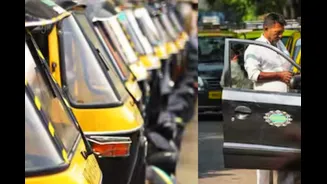
The most immediate impact of the dispute has been felt on Mumbai’s roads. With a section of autorickshaw, kaali-peeli taxi and app-based cab drivers staying off the roads, commuters have found it increasingly difficult to secure a ride, particularly during peak hours. The shortage has reportedly created the conditions for surge pricing on ride-hailing platforms, where fares fluctuate according to demand and vehicle availability.
On Tuesday morning, between 8 am and 11 am, commuters reported paying significantly more than usual for several routes. A roughly 10-km autorickshaw journey that would ordinarily cost around Rs 250-300 on an app during a weekday peak period was reported at more than Rs 450 in some cases.
The government-approved meter fare for a 10-km autorickshaw journey is considerably lower, at around Rs 172. This means that app-based prices during the shortage can be more than twice the metered fare.
The actual amount displayed to a commuter can, however, vary depending on the platform, time of booking, demand and the number of vehicles available.
Common Mumbai Routes See Sharp Fare Surges
The fare increases have not been limited to longer journeys. Even relatively short trips have become substantially more expensive.
According to a report by India Today, a journey from Powai to Versova, covering roughly 15 km, which previously cost around Rs 350 by autorickshaw, was reported at approximately Rs 589 on Tuesday morning. On the shorter Juhu to Ranwar Village route in Bandra, covering around 7.5 km, fares on several ride-hailing applications were reported to range between Rs 350 and Rs 430 during the morning peak.
For commuters making longer cross-city journeys, the increase has been even more noticeable.
A journey between Borivali on the Western Line and Chembur on the Harbour Line, covering approximately 28.5 km, saw autorickshaw fares rise above Rs 600 on major ride-hailing platforms during peak hours.
These prices are not fixed and can change within minutes as demand and availability shift.
Commuters Take To Social Media
Mumbai commuters have been documenting the disruption online, with several reporting both longer waiting times and substantially higher fares. Musician Avantika Ganguly said she waited around 45 minutes for an autorickshaw, compared with the roughly five-minute wait she normally experienced, and claimed she eventually paid three times the usual fare.
She attributed the shortage to the Marathi language checks and alleged that some drivers were avoiding peak-hour operations or were reluctant to accept longer trips because of the ongoing enforcement. She also questioned the manner in which the language requirement was being implemented, arguing that the authorities should consider the circumstances of drivers who have spent decades working on Mumbai’s roads.
What kind of Gundagardi is this??
Lady sitting in a cab and auto drivers are fighting with cab drivers..
Government has given enough time to learn Marathi..not just time but they have arranged training sessions too..
If you are not willing to learn the local language where you… pic.twitter.com/E2W1voksxu
— Trupti Garg (@garg_trupti) August 24, 2026
Former Malayalam actress and classical dancer Divya Unni also criticised the approach, arguing that drivers should be given sufficient time and support to learn Marathi rather than being subjected to what she described as harassment or excessive penalties.
Her comments have added to a wider public debate over whether the language requirement can be implemented without disproportionately affecting workers who have limited formal education or have spent years in the profession.
Viral ‘Easy Marathi Test’ Video Adds Fuel To Debate
Amid the growing controversy, videos relating to the Marathi proficiency checks have circulated widely on social media.
One such video has been described online as showing the supposedly simple, practical nature of the test, while other footage circulating amid the row has purportedly shown heated exchanges involving drivers.
Look how Difficult Marathi Language Test for Mumbai Auto Drivers is
They are FORCED To answer such BASIC questions by this Kind Lady
How will their Giant Bimaru Egos handle answering such SIMPLE questions??? pic.twitter.com/yVp3U8k6G3
— Anmol (@Anmol_299) August 25, 2026
The videos have prompted sharply different reactions. Supporters of the government’s move have argued that drivers serving passengers in Maharashtra should be able to communicate in the state’s official language. Critics, meanwhile, have questioned whether roadside testing and enforcement are the appropriate way to achieve that objective.
The Maharashtra Transport Department has said the exercise is intended to assess a driver’s working knowledge of Marathi rather than advanced fluency. The test is based on everyday interactions that drivers are likely to have with passengers, including destinations, fares, routes and other routine requests.
However, some drivers have alleged that they were asked questions they considered outside the material covered during their training. Reports of such complaints have further intensified the dispute.
Drivers Claim Tests Are Not As Simple As They Appear
The central grievance among protesting drivers is not necessarily opposition to learning Marathi, but the way the requirement is being enforced.
Several drivers have claimed that the practical checks are difficult for older workers who have had little formal schooling.
One driver, speaking amid the protests, said that many workers in their 50s and 60s had never attended school and questioned how they could suddenly be expected to meet a language requirement while continuing to work long hours.
Other drivers have said they have attended Marathi classes but still struggled to respond during the roadside assessments.
The government, however, has maintained that drivers are being given an opportunity to improve rather than being immediately removed from the profession. Drivers who fail to demonstrate adequate working knowledge have been issued notices and given time to learn the language.
Thousands Of Drivers Already Checked Across Maharashtra
The enforcement drive began on August 20, with RTO flying squads checking commercial passenger vehicle drivers across Maharashtra. On the first day, 8,217 taxi and autorickshaw drivers were tested across the state. In the Mumbai Metropolitan Region, 3,995 drivers were checked and 604 were issued show-cause notices. Around 85% of drivers tested in both the MMR and the rest of Maharashtra demonstrated satisfactory proficiency.
By Monday, the cumulative numbers had increased considerably. RTO teams had inspected 35,190 commercial passenger vehicles across Maharashtra, including 14,399 in the MMR, with 4,729 notices issued statewide and 2,239 in the MMR.
The government has said drivers who receive notices will have an opportunity to improve their Marathi. Continued non-compliance after the prescribed period could eventually result in suspension of their badges.
Why The Government Says Marathi Is Required
The Maharashtra government has defended the enforcement drive, arguing that drivers providing public transport services should have a basic ability to communicate with passengers in the state’s official language.
Transport Minister Pratap Sarnaik has said the requirement is linked to passenger convenience and safety. The government has also stressed that drivers are not being expected to become Marathi scholars, but should possess enough working knowledge to handle routine conversations with passengers.
The state has also taken steps aimed at making compliance easier. According to recent reports, 161 Marathi training centres are being established across Maharashtra, along with a dedicated RTO helpline to address complaints about implementation, alleged harassment and irregularities.
Mobility platform Rapido has separately launched Marathi-learning resources for its bike, auto and cab driver partners, allowing them to access lessons through its app, YouTube channels and other platforms.
Drivers Take Their Protest Beyond The Roads
The language dispute has also led to a three-day strike by a section of auto and taxi drivers. The strike has reduced the number of vehicles available to commuters at a time when Mumbai is already dealing with heavy monsoon traffic and long travel times.
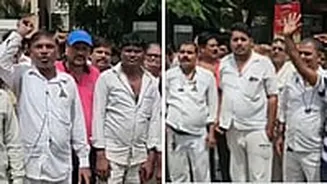
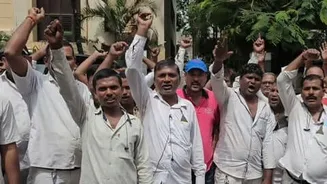
A section of drivers has also protested on roads, including an incident in Kandivali where protesters attempted to block traffic. Police detained several protesters during the demonstration, according to reports.
The shortage has been particularly difficult for office-goers, students and other passengers who depend on autos and taxis for the first and last legs of their daily journeys.
Videos Show Drivers Heading Home Amid The Row
Another set of images and videos circulating online has added a more dramatic dimension to the dispute.
Footage purporting to show autorickshaw and taxi drivers from Uttar Pradesh and Bihar returning to their native states has been widely shared amid the controversy. Separate visuals from the Pawan Express, which runs from Lokmanya Tilak Terminus in Mumbai to Jaynagar in Bihar via Darbhanga, show crowded coaches as passengers seek to travel towards their home states.
Auto and taxi drivers from UP and Bihar returning home amid the Marathi language rule dispute, thousands of passengers rushed to trains bound for their native states.
These scenes from Pawan Express that runs between Lokmanya Tilak Terminus (Mumbai) and Jaynagar, Bihar, via… pic.twitter.com/kUZUm1dP2W
— Gems Of Railway (@GemsOfRailway) August 25, 2026
However, the connection between individual passengers shown in such footage and the Marathi language dispute cannot be independently established from the videos alone.
A separate viral video has also reportedly shown an autorickshaw being loaded onto a train, with claims online that the driver was leaving Mumbai because he could not speak Marathi. Such claims have generated considerable debate, although the circumstances surrounding individual videos should be treated cautiously unless independently verified.
The Row Is Also Producing Unusual Scenes On Mumbai’s Roads
The language requirement has produced some unexpected consequences. A Times of India report noted that some drivers have begun using newly acquired Marathi phrases even while refusing rides, giving a humorous twist to the enforcement drive.
At the same time, footage and reports of arguments between drivers, passengers and officials have continued to circulate online.
The broader concern for commuters, however, remains practical: fewer vehicles, longer waits and higher fares.
Auto And Taxi Fares Were Already Set To Rise
The current surge in app fares is separate from the official fare increase approved earlier this month. The Mumbai Metropolitan Region Transport Authority approved revised base fares on August 20. Under the new structure, the minimum autorickshaw fare will rise to Rs 27 for the first 1.5 km, while the minimum fare for kaali-peeli taxis will rise to Rs 33.
The increases amount to Re 1 for autorickshaws and Rs 2 for taxis. The fare revision was attributed to rising fuel and operating costs.
The revised fares therefore add another layer to the current situation: commuters are facing an increase in the regulated base fare while simultaneously encountering much higher app prices because of reduced vehicle availability.
From Rs 172 Meter Fare To Rs 450-Plus App Ride
The difference becomes particularly striking when the figures are placed side by side. For a 10-km autorickshaw journey, the government-approved meter fare is around Rs 172. On ride-hailing applications, a comparable journey during normal peak-hour conditions can be around Rs 250-300.
But amid the present shortage, commuters have reported paying more than Rs 450 for similar journeys.
That effectively places some app fares at more than 2.5 times the government-approved meter rate.
The exact comparison is not always like-for-like because app platforms may include dynamic pricing, booking charges and other components. Nevertheless, the shortage has clearly pushed the cost of securing an auto significantly higher for many passengers.
Commuters Caught Between A Policy Dispute And A Transport Crisis
For passengers, the argument over language policy has become inseparable from the question of simply getting to work, college, home or a railway station.
One commuter said finding an auto had become unusually difficult and expensive, with the disruption causing her to reach work 45 minutes late. Another commuter compared Mumbai’s traditional autorickshaw system favourably with the experience in Delhi, saying Mumbai’s autos had generally been more efficient and dependable, but that the current disruption was affecting millions who rely on them.
The concern is particularly significant in a city where autos and taxis form a crucial part of the public transport ecosystem, connecting residential neighbourhoods with suburban railway stations, offices and commercial areas.
Government Faces Pressure To Balance Enforcement And Livelihoods
The Maharashtra government’s position is that the requirement is about basic communication, not linguistic perfection. The transport department has also indicated that drivers will be given an opportunity to learn Marathi before punitive action is taken.
Drivers and their supporters, however, argue that the enforcement process needs to account for age, education, years of service and the practical difficulties of learning a new language while working long hours.
The controversy has also reached the legal arena, with a Public Interest Litigation challenging the state’s Marathi requirement for auto-rickshaw, taxi and app-based cab drivers expected to be filed before the Bombay High Court.
What Happens Next?
The Marathi proficiency drive is continuing, while the fallout from the strike is being felt across Mumbai’s transport network.
The state has announced training centres and a helpline in an attempt to address concerns, while the transport department continues its inspections. The government has also said the enforcement drive will continue through September 30.
For commuters, the immediate situation remains less about the politics of the language debate and more about availability and affordability. Until the dispute is resolved and more drivers return to the roads, Mumbaikars may continue to face a familiar problem in an unfamiliar form: the auto is harder to find, the wait is longer and the fare on the screen is considerably higher.