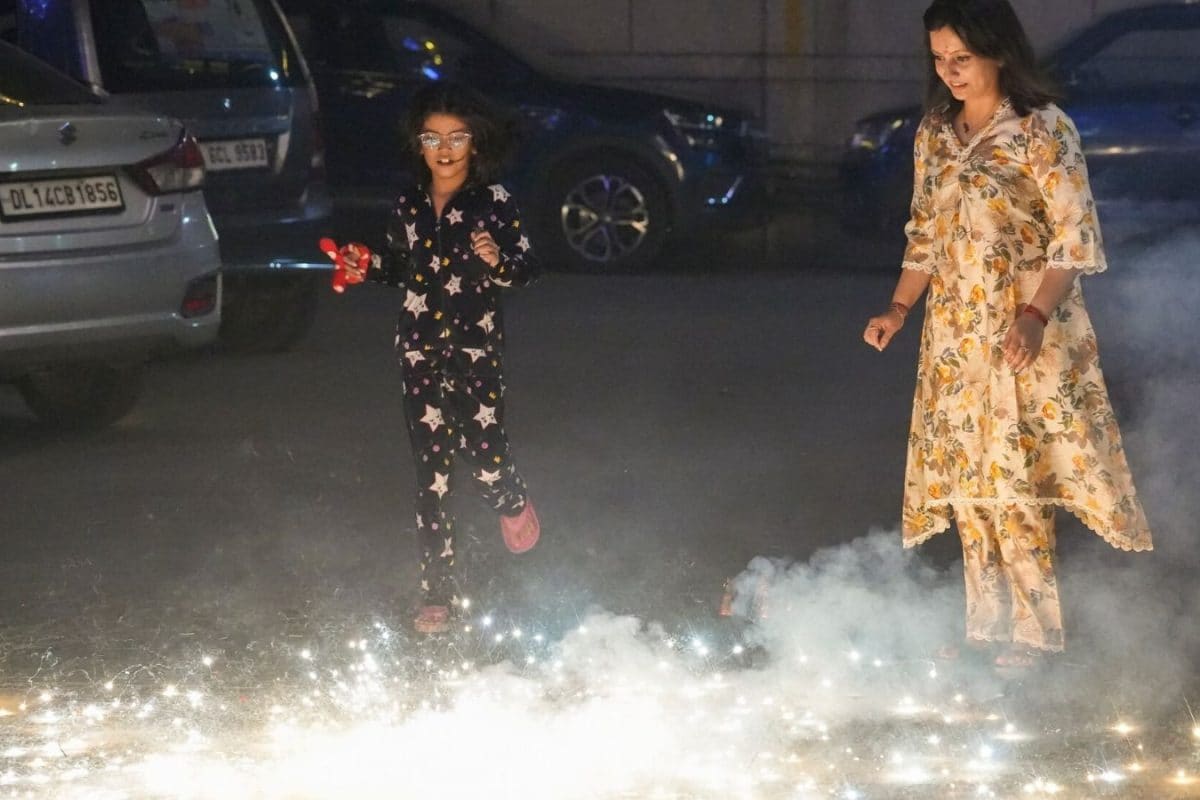








The Supreme Court on Thursday said it was not inclined to impose a complete ban on firecrackers during Diwali, observing that it did not want to hurt anyone’s feelings. The court, however, stressed the
need for strict enforcement of existing rules to curb pollution caused by firecrackers.
The bench also suggested that the Delhi government use prominent public figures to spread awareness about the harmful effects of firecrackers, naming celebrated cricketer Virat Kohli as a possible choice.
“Why don’t you use public figures for spreading awareness? Why don’t you use a celebrated cricketer like Virat Kohli to spread awareness?” the bench asked the Delhi government.
The court observed that Diwali celebrations could boost morale and promote positivity, while emphasising the need to balance festive sentiments with measures to address air pollution.
‘We’ve Pulled Up Our Socks For Pollution Season’: Delhi Govt Tells Supreme Court
The Delhi government on Wednesday told the Supreme Court that it was prepared to tackle the pollution season, saying it had put several measures in place to curb air pollution in the national capital.
“We have pulled up our socks and are geared up for the pollution season,” Additional Solicitor General Aishwarya Bhati, appearing for the Delhi government and the Commission for Air Quality Management (CAQM), told the top court. She added that, unlike previous years, the authorities were ready to deal with the challenge.
The submissions were made during a hearing in the firecrackers case, as the court was apprised of the impact of air pollution on public health and the measures being taken to control it.
Delhi Govt Lists Anti-Pollution Measures
ASG Bhati told the court that vehicles coming from outside Delhi that do not comply with BS-VI emission standards would not be permitted to enter the national capital from November 1. She also listed several other measures, including staggered timings for government offices to reduce traffic congestion, the deployment of anti-smog guns near construction sites and the implementation of an annual anti-pollution plan.
The government has also put control centres and the Vayu Rakshak initiative in place, Bhati said, adding that 608 anti-smog guns had been deployed.
Amicus Flags Health Impact Of Air Pollution
During the hearing, the amicus curiae highlighted the impact of air pollution on residents’ health and life expectancy, saying the court that Delhi residents lose an estimated 4.7 years of life due to PM2.5 pollution.
The amicus also cited observations by chest surgeons in Delhi, saying that while doctors in the 1980s generally saw pink lungs in patients except smokers, they now regularly encountered patients with black deposits in their lungs, including children aged 14 and 16 who had no history of smoking.
The amicus further said that, while smokers accounted for 90% of lung cancer patients in the 1980s, non-smokers now account for around half of such cases.
‘Even Minor Celebrations Raise AQI’: Amicus On Firecrackers
The amicus told the Supreme Court that Delhi’s air quality index (AQI) had risen to 241 after Dussehra, arguing that even minor celebrations could lead to a spike in pollution.
Senior advocate Gopal Sankaranarayanan also told the court that fireworks were still being set off.
The amicus cautioned that green crackers were not pollution-free, saying they had only 30% lower emissions. The submissions highlighted concerns over the effectiveness of measures to limit pollution during festive celebrations.